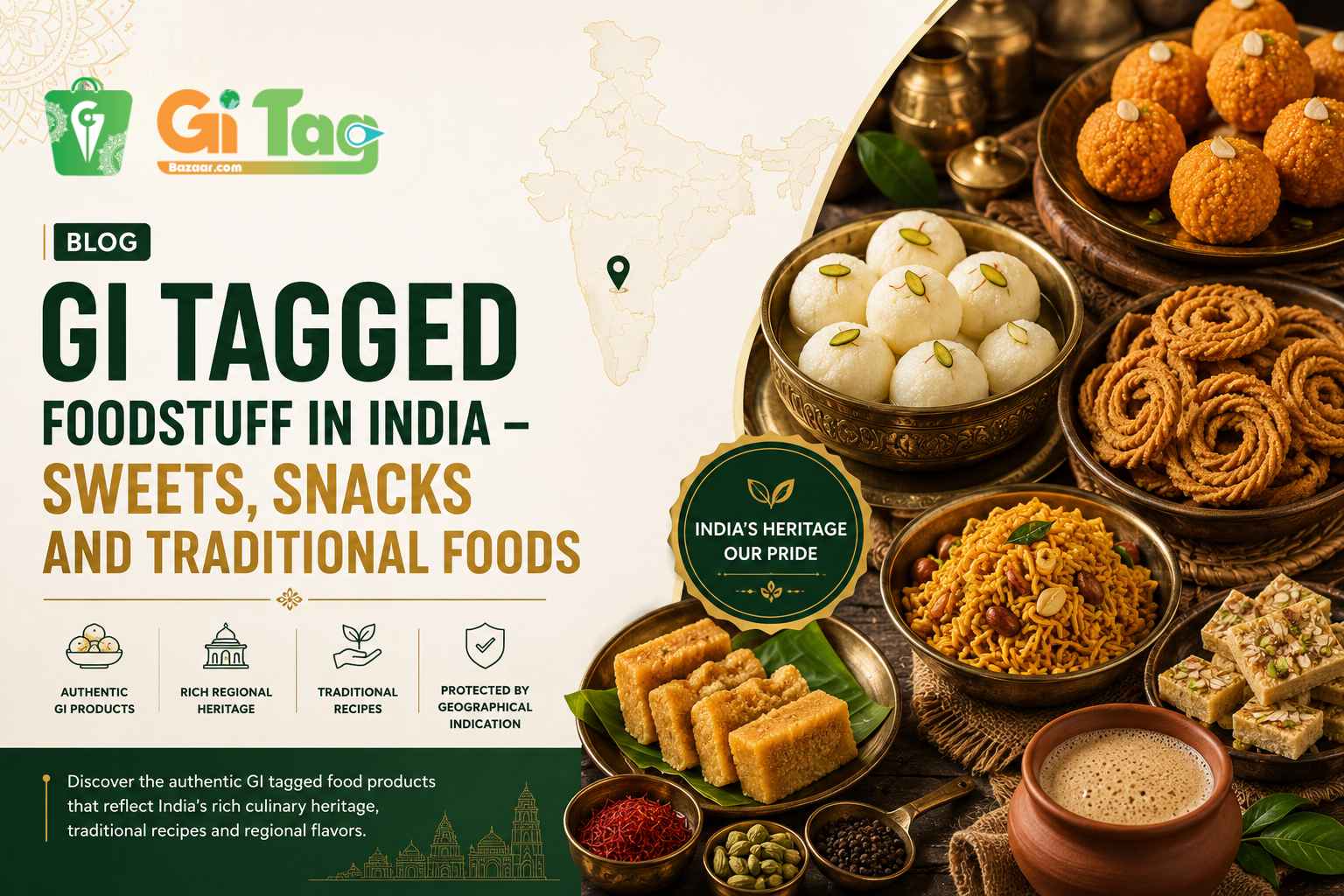
GI Tagged Foodstuff in India – Sweets, Snacks and Traditional Foods
The GI tagged foodstuff products in India cover heritage foods like Tirupati Laddu, Bikaneri Bhujia, and Kashmir Kesar that possess unique regional recipes. This master directory explains the traditional ingredients, authentic cooking methods, and official origin certifications for India’s protected regional foods.
Table of Contents
- What are GI Tagged Foodstuff Products in India?
- Which are the Famous GI Tagged Temple Sweets and Prasadam from India?
- What are the GI Tagged Traditional Milk Sweets from India?
- What are the GI Tagged Spicy Snacks and Namkeen from India?
- Which is the GI Tagged Spice from India and Why is it Special?
- What is the GI Tagged Slow-Cooked Dish from India?
- How can a Buyer Authenticate a GI Tagged Foodstuff Product?
- Frequently Asked Questions About GI Tagged Foodstuff in India
What are GI Tagged Foodstuff Products in India?
GI tagged foodstuff products in India are traditional dishes and snacks that carry government origin certification due to their unique local ingredients and historical cooking methods. The registry ensures that only authorized regional producers can legally sell these specific regional delicacies.
The Geographical Indication system categorizes foodstuff separately from raw agricultural crops. The registry evaluates both the sourcing of the ingredients and the precise recipe execution. A registered food item must prove a deep historical connection to its geographical origin. You can read our guide on what is a GI tag and its legal protection to understand the certification process.
The GI Registry in Chennai strictly controls the commercial use of these food names. An authorized user must follow the exact traditional preparation method. They cannot alter the core ingredients. This strict intellectual property protection stops commercial brands from mass-producing cheap imitations. We explain this legal framework deeply in our GI tag full form and meaning article.
Which are the Famous GI Tagged Temple Sweets and Prasadam from India?
Tirupati Laddu is the most famous GI tagged temple sweet in India, produced exclusively within the temple kitchen using a strictly fixed historical recipe. This origin certification protects the sacred prasadam from unauthorized commercial exploitation by private sweet vendors.
Prasadam holds immense cultural significance in India. The government protects specific temple offerings to maintain their ritual purity and distinct taste.
Tirupati Laddu Tirupati Laddu originates from Tirumala Tirupati in Andhra Pradesh. The government granted its GI registration in 2009. The Tirumala Tirupati Devasthanams (TTD) acts as the sole authorized producer. The unique characteristic of this sweet is its fixed dittam recipe. The temple cooks prepare it inside the sacred potu kitchen using specific quantities of cashews, cardamom, and sugar. The TTD offers this laddu only to Lord Venkateswara devotees as a holy prasadam. You can explore other GI tagged products from Andhra Pradesh on our regional page.
What are the GI Tagged Traditional Milk Sweets from India?
Dharwad Pedha and Mysore Pak are the premium GI tagged milk sweets from Karnataka that feature slow cooking techniques and pure dairy ingredients. The local sweet makers use specific caramelization methods and high-quality ghee to achieve their distinct textures.
Milk sweets require intense labor and precise temperature control. The registered varieties maintain the exact recipes created generations ago.
Dharwad Pedha Dharwad Pedha comes from Dharwad in Karnataka. The registry approved this milk sweet in 2007. The preparation method involves slow-cooking the khoya (milk solids) over a low flame. The sweet makers caramelize the sugar slowly to create a distinct dark brown color.
Mysore Pak Mysore Pak originates from Mysore in Karnataka. The key ingredients include pure ghee, besan (gram flour), and sugar. The sweet makers use a rapid ghee-based cooking technique. The royal palace kitchen of Mysore first created this sweet in 1935. You can view more details on our GI tagged products from Karnataka directory.
How is Dharwad Pedha different from regular peda?
Dharwad Pedha features a unique caramelized dark brown color and a distinct grainy texture. The artisans achieve this specific texture by slow-cooking the khoya over a low flame for several hours rather than boiling it quickly.
What makes Mysore Pak a GI tagged sweet?
The unique porous and melt-in-mouth texture makes Mysore Pak a GI tagged sweet. The artisans achieve this texture by continuously pouring hot pure ghee into the besan mixture during the final rapid cooking stage.
What are the GI Tagged Spicy Snacks and Namkeen from India?
Bikaneri Bhujia and Ratlami Sev are the iconic GI tagged spicy snacks from India that utilize specific regional flours and distinct spice blends. The local climate conditions directly influence the final crispy texture of these traditional dry namkeen products.
Dry snacks form a crucial part of the daily Indian diet. The registered namkeen products offer superior taste due to their authentic local ingredients.
Bikaneri Bhujia Bikaneri Bhujia originates from Bikaner in Rajasthan. The government registered this crispy namkeen in 2010. The dry desert climate of Bikaner supports the cultivation of the moth bean legume. This specific moth bean flour serves as the key ingredient. The artisans fry the spiced batter in a specific sequence to create ultra-thin crispy strands. You can explore more GI tagged products from Rajasthan on our state page.
Ratlami Sev Ratlami Sev comes from Ratlam in Madhya Pradesh. The key ingredients include gram flour, whole cloves, black pepper, and asafoetida. The unique characteristic of this snack is its thick crispy strands. The strong clove and pepper provide a distinct heat profile.
What makes Bikaneri Bhujia different from ordinary bhujia?
Bikaneri Bhujia uses specific moth bean flour grown entirely in the dry desert climate of Bikaner. The local climate conditions and the unique moth bean legume give the final fried strands an ultra-crispy texture that ordinary gram flour cannot replicate.
Which is the GI Tagged Spice from India and Why is it Special?
Kashmir Kesar is the premier GI tagged spice from India, recognized globally for having the highest crocin content and the deepest red color. The local farmers cultivate this premium saffron exclusively on the high-altitude karewa plateaus of Jammu and Kashmir.
Saffron is the most expensive spice in the world by weight. The Indian registry protects the authentic Kashmiri harvest from cheap foreign adulteration.
Kashmir Kesar Kashmir Kesar originates from Pampore in Jammu and Kashmir. The government granted its GI registration in 2020. The farmers cultivate this spice on karewa highland plateaus situated above 1,600 metres altitude. The unique characteristic of Kashmir Kesar is its intense aroma and deep red color. The harvesting season occurs only from October to November. The manual extraction of the delicate stigmas requires immense skill. We explain this complex process in our article on how Kashmir Kesar is harvested. You can also view other GI tagged products from Jammu and Kashmir.
What is the GI Tagged Slow-Cooked Dish from India?
Hyderabadi Haleem is the famous GI tagged slow-cooked dish from India that features a rich blend of mutton, wheat, and specific regional spices. The cooks prepare this nutritious porridge in large copper vessels over firewood for eight continuous hours.
Cooked meals rarely achieve geographical indication status. The complex cooking technique and the strict ingredient ratios helped this dish secure its unique legal protection.
Hyderabadi Haleem Hyderabadi Haleem originates from Hyderabad in Telangana. The registry approved this dish in 2010. The cooks simmer the mutton and wheat base in a large cooking vessel called a deg. The 8-hour slow-cooked process breaks down the meat completely. The cooks mash the ingredients continuously with heavy wooden poles. This dish serves as a Ramadan special. Consumers can now find it year-round in certified restaurants across Hyderabad.
How can a Buyer Authenticate a GI Tagged Foodstuff Product?
Buyers can authenticate a GI tagged foodstuff product by checking the packaging for the official GI logo, verifying the authorized producer registration numbers, and buying from certified sellers. Authentic products always carry clear regional sourcing documentation.
Counterfeit food products flood the domestic market. Consumers must learn to identify genuine regional items to ensure food safety and authentic taste. You can learn to buy authentic GI tagged foods online safely using our guide.
You can verify authentic GI foodstuff using these steps:
- Look for the official Geographical Indication logo on the packet.
- Verify the specific TTD seal on Tirupati Laddu packaging.
- Check the ISO grade certificate for Kashmir Kesar purchases.
- Demand the registered producer number from the online seller.
- Purchase directly from state emporiums or verified seller platforms.
The IP India portal maintains the complete list of authorized food producers. You should avoid unbranded street vendors when seeking authentic GI certified sweets and snacks.
Frequently Asked Questions About GI Tagged Foodstuff in India
Is Tirupati Laddu only made inside the temple?
Yes. Tirupati Laddu is only made inside the temple. The strict GI certification ensures that only the TTD cooks operating the sacred potu kitchen can produce the authentic prasadam using the fixed historical dittam recipe.
Does Kashmir Kesar have the highest quality saffron in the world?
Yes. Kashmir Kesar has the highest quality saffron in the world. The official ISO grade comparison proves that this high-altitude spice contains the highest crocin content globally, giving it the deepest red color and strongest aroma.
How many GI tagged foodstuff products exist in India?
More than 35 GI tagged foodstuff products currently exist in India. The official registry recently added new regional delicacies like the traditional Nolen Gur sweets from West Bengal and the Kavindapadi Nattu Sakkarai jaggery from Tamil Nadu.
Was Hyderabadi Haleem the first non-vegetarian GI tagged product in India?
Yes. Hyderabadi Haleem was the first non-vegetarian GI tagged product in India. The Geographical Indications Registry granted this historic milestone status in 2010 due to the unique 8-hour traditional cooking process and specific regional spice blend.
Where can I buy authentic GI tagged sweets and snacks online?
Buyers can buy authentic GI tagged sweets and snacks online through verified government e-marketplaces and certified regional seller platforms. These authorized channels display the proper registration numbers and source directly from the registered local food producers.