What is a GI Tag – Meaning, Purpose, and How Geographical Indications Protect India’s Heritage Products
A GI Tag (Geographical Indication Tag) is an intellectual property right that certifies a product originates from a specific geographical region and possesses qualities, reputation, or characteristics linked to that origin. The Geographical Indications of Goods (Registration and Protection) Act, 1999 governs GI protection in India. Over 650 products across 6 categories – agriculture, handicraft, textile, foodstuff, manufactured goods, and natural goods hold registered GI Tags as of 2026.
What Does GI Tag Mean?
A GI Tag is a certification mark issued by the Government of India that guarantees a product originates from a defined geographical area and possesses unique qualities directly attributable to that place of origin. Darjeeling Tea, Banarasi Silk, and Alphonso Mango are 3 well-known examples of GI tagged products.
Geographical Indication (GI) is a form of intellectual property right. The term “Geographical Indication” refers to a name or sign used on products that correspond to a specific geographical location. The product must possess qualities, reputation, or characteristics that are essentially due to that origin.
A GI Tag functions as an origin certification for consumers and a legal shield for producers. Buyers receive proof that the product is authentic. Producers receive legal protection against counterfeiting and imitation.
The Geographical Indications Registry in Chennai administers all GI registrations in India. This registry operates under the Controller General of Patents, Designs and Trade Marks, which falls under the Department for Promotion of Industry and Internal Trade (DPIIT), Ministry of Commerce and Industry.
What is the Full Form of GI Tag?
GI Tag stands for Geographical Indication Tag. The full legal term used in Indian law is “Geographical Indication of Goods” as defined under the Geographical Indications of Goods (Registration and Protection) Act, 1999.
What is the Difference Between GI Tag and Geographical Indication?
Geographical Indication is the intellectual property concept. GI Tag is the certification applied to a product after successful registration. The GI Tag is the visible label or mark on the product packaging. Geographical Indication is the broader legal right that the tag represents.
Why Do GI Tags Exist in India?
GI Tags exist in India to protect traditional products from counterfeiting, to preserve indigenous knowledge and craftsmanship, and to provide legal and economic benefits to artisans, farmers, and regional producers who create heritage products tied to specific places.
3 core problems drove India to create the GI system:
- Counterfeiting – Products like Darjeeling Tea, Kanchipuram Silk, and Kashmir Pashmina faced widespread imitation by sellers outside the original region.
- Economic loss – Regional artisans and farmers lost market share and pricing power to counterfeit products sold under the same name.
- Heritage erosion – Traditional production methods risked disappearing because producers could not compete with cheap imitations.
How Does the GI Act 1999 Protect Products?
The Geographical Indications of Goods (Registration and Protection) Act, 1999 became effective on September 15, 2003. This law provides the legal framework for registering and protecting GI products in India.
The GI Act 1999 establishes 2 types of registration:
- Part A registers the Geographical Indication itself with the product name, its geographical origin, and the association between the product and its place of origin.
- Part B registers Authorized Users with the specific producers, cooperatives, or entities legally permitted to use the GI tag on their products.
Unauthorized use of a registered GI is a punishable offence under this Act. Any party that misuses a registered GI name faces legal action, including injunctions and damages.
Which Government Body Issues GI Tags in India?
The Geographical Indications Registry, located in Chennai, Tamil Nadu, issues all GI Tags in India. This registry operates under the Controller General of Patents, Designs and Trade Marks. The parent authority is DPIIT (Department for Promotion of Industry and Internal Trade), Ministry of Commerce and Industry, Government of India.
What Are the 6 Categories of GI Tagged Products?
India’s GI Registry classifies all registered products into 6 official categories: Agriculture, Handicraft, Textile, Foodstuff, Manufactured Goods, and Natural Goods. Agriculture holds the highest number of registered GI products, followed by Handicraft and Textile.
| Category | Total Products (approx.) | Top Examples |
|---|---|---|
| Agriculture | 200+ | Darjeeling Tea, Alphonso Mango, Basmati Rice, Malabar Pepper |
| Handicraft | 150+ | Kashmiri Carpet, Blue Pottery of Jaipur, Bidriware |
| Textile | 120+ | Kanchipuram Silk, Banarasi Silk, Pochampally Ikat |
| Foodstuff | 60+ | Tirupati Laddu, Bikaneri Bhujia, Dharwad Pedha |
| Manufactured Goods | 40+ | Mysore Sandal Soap, Nashik Valley Wine |
| Natural Goods | 30+ | Makrana Marble, Shilajit |
Agriculture GI Products
Agriculture GI products include crops, fruits, spices, tea, and cereals that derive unique qualities from their growing region’s climate, soil, and altitude. 5 notable examples are Darjeeling Tea, Alphonso Mango, Basmati Rice, Malabar Pepper, and Assam Tea.
Darjeeling Tea’s muscatel aroma develops only at altitudes between 600 and 2,000 meters in the Darjeeling district. Alphonso Mango from Ratnagiri develops its distinct creamy texture due to the laterite soil and coastal climate of the Konkan region.
Handicraft GI Products
Handicraft GI products encompass artisan-made items produced using traditional techniques passed down across generations. 4 prominent examples are Kashmiri Hand Knotted Carpet, Blue Pottery of Jaipur, Bidriware, and Channapatna Toys.
Kashmiri carpets require 6 to 18 months of hand-knotting by skilled artisans. The knot density ranges from 324 to 900 knots per square inch, making each carpet a unique heritage product.
Textile GI Products
Textile GI products cover handloom fabrics, sarees, shawls, and embroidered garments that carry region-specific weaving traditions. 4 well-known examples are Kanchipuram Silk Saree, Chanderi Sarees, Pochampally Ikat, and Lucknow Chikankari.
Kanchipuram Silk uses mulberry silk threads with zari woven on traditional jacquard looms. The saree body and border are woven separately and interlocked a technique unique to Kanchipuram weavers in Tamil Nadu.
View all GI tagged textile products from India.
Foodstuff GI Products
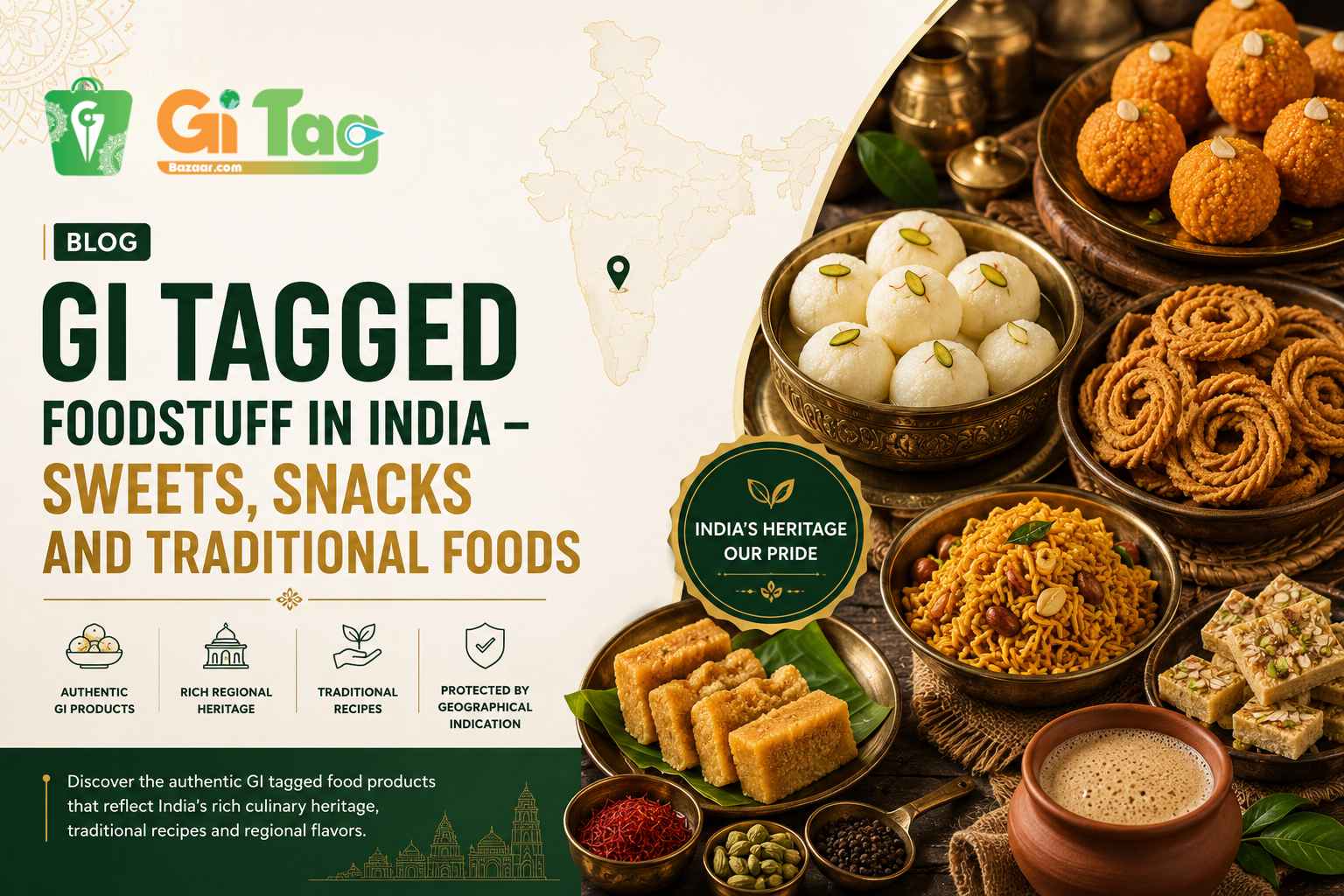
Foodstuff GI products include traditional sweets, snacks, spices, and prepared foods with heritage recipes tied to their origin. 4 examples are Tirupati Laddu, Bikaneri Bhujia, Dharwad Pedha, and Kashmir Kesar.
Kashmir Kesar (saffron) grows exclusively in the Pampore region of Jammu and Kashmir. The Crocus sativus flowers are hand-picked at dawn, and each flower produces only 3 stigma strands making it one of the world’s most expensive spices by weight.
Discover all GI tagged foodstuff products from India.
Manufactured Goods GI Products
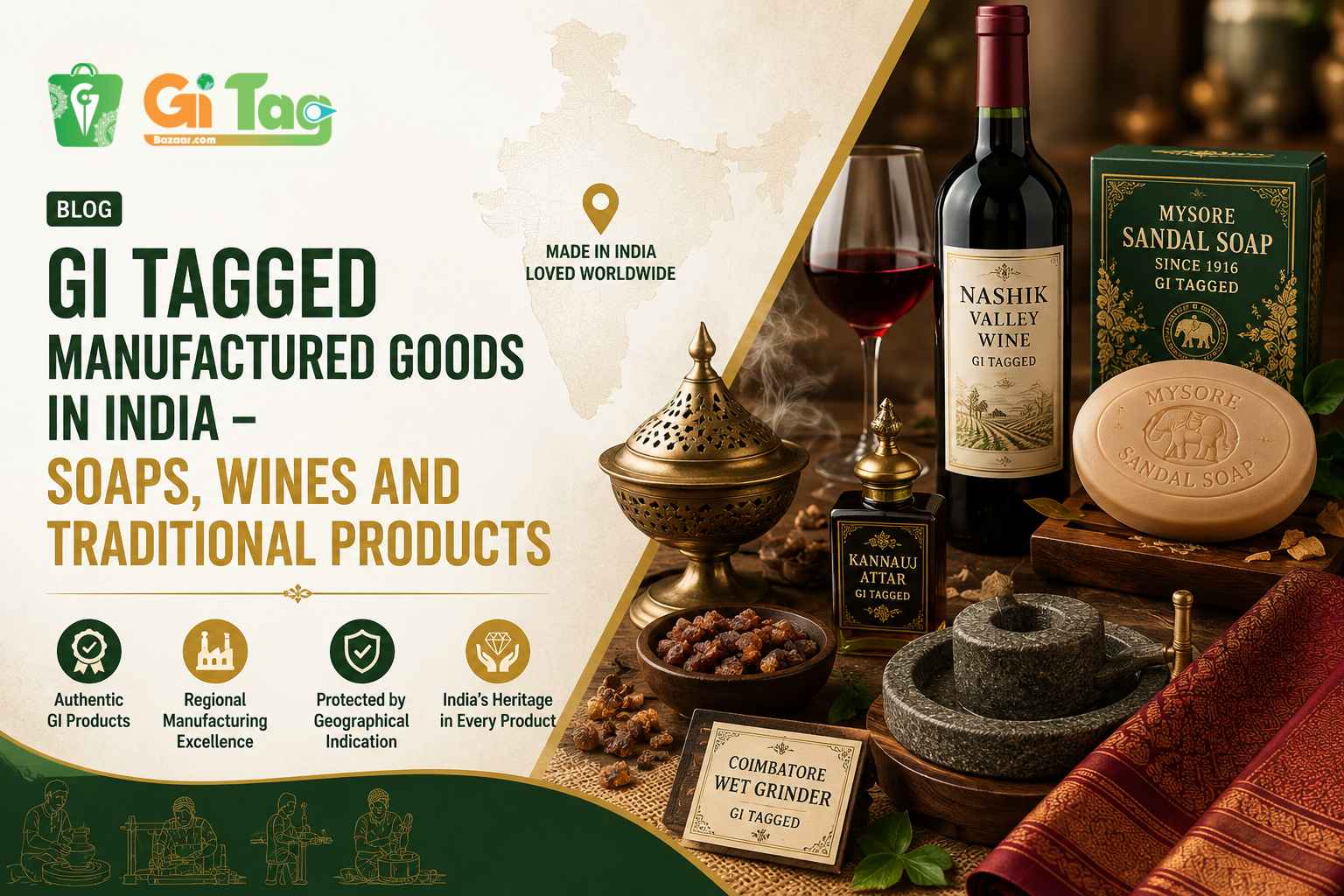
Manufactured Goods GI products are industrial or processed items that derive distinctive characteristics from regional manufacturing processes. 3 examples are Mysore Sandal Soap, Nashik Valley Wine, and Coimbatore Wet Grinder.
Mysore Sandal Soap uses pure sandalwood oil sourced from Karnataka’s government sandalwood depot. The formulation dates to 1916 and remains identical to the original recipe.
See all GI tagged manufactured goods from India.
Natural Goods GI Products
Natural Goods GI products are raw materials or naturally occurring substances specific to a region. Makrana Marble from Rajasthan is a notable example. This white marble, quarried from the Makrana mines in Nagaur district, built the Taj Mahal.
Which Was the First GI Tagged Product in India?
Darjeeling Tea became the first product to receive a GI Tag in India in 2004–05. It holds GI registration number GI/1/1999/1 which is the very first entry in India’s Geographical Indications Registry.
The Tea Board of India filed the application in 1999, immediately after the GI Act came into force. The registration protects the name “Darjeeling” for tea grown exclusively in the Darjeeling district of West Bengal. Tea produced outside this defined area cannot legally use the Darjeeling name.
Darjeeling Tea’s GI protection covers tea grown in 87 registered tea gardens spread across the Darjeeling hills. The altitude (600–2,000 meters), cool temperatures, and specific soil composition create the famous muscatel flavour that distinguishes Darjeeling Tea from all other Indian teas.
Experience authentic Darjeeling Tea with GI certification on GI Tag Bazaar.
How Many GI Tagged Products Exist in India in 2026?
India has over 650 registered GI tagged products as of April 2026, covering all 28 states and 8 union territories. This number increases every year as new applications are processed by the GI Registry. View the complete list of GI tagged products in India for the full directory.
Which States Have the Most GI Tags?
Karnataka leads India with over 50 registered GI products, followed by Tamil Nadu, Kerala, Uttar Pradesh, and Maharashtra. The top 10 states by GI registrations are:
| Rank | State | GI Products (approx.) | Top Product Examples |
|---|---|---|---|
| 1 | Karnataka | 50+ | Mysore Silk, Bidriware, Channapatna Toys |
| 2 | Tamil Nadu | 45+ | Kanchipuram Silk, Thanjavur Art Plate, Madurai Sungudi |
| 3 | Kerala | 35+ | Malabar Pepper, Alleppey Coir, Aranmula Kannadi |
| 4 | Uttar Pradesh | 35+ | Lucknow Chikankari, Banarasi Silk, Allahabad Surkha Guava |
| 5 | Maharashtra | 30+ | Alphonso Mango, Nashik Grapes, Paithani Saree |
| 6 | Madhya Pradesh | 25+ | Chanderi Saree, Bagh Print, Ratlami Sev |
| 7 | Andhra Pradesh | 20+ | Kondapalli Toys, Banaganapalle Mango, Tirupati Laddu |
| 8 | Odisha | 20+ | Pattachitra, Sambalpuri Saree, Odisha Rasagola |
| 9 | Rajasthan | 20+ | Blue Pottery of Jaipur, Bikaner Bhujia, Kota Doria |
| 10 | West Bengal | 15+ | Darjeeling Tea, Baluchari Saree, Banglar Muslin |
Explore the complete state-wise directories: GI tagged products of Karnataka and GI tagged products of Maharashtra.
Which GI Products Were Recently Tagged in 2025–2026?
18 new products received GI registration in 2025–2026. Notable additions include:
- Ponduru Khadi (Andhra Pradesh): hand-spun and hand-woven fabric from Srikakulam, registered January 2026
- Taleigao Vayingim (Goa): traditional brinjal variety, registered January 2026
- Kavindapadi Nattu Sakkarai (Tamil Nadu): organic jaggery, registered 2026
- Thooyamalli Rice (Tamil Nadu): heritage rice variety, registered 2026
- Ryndia (Meghalaya): eco-friendly Ahimsa silk fabric, registered 2025
- Banglar Muslin (West Bengal): revival of historic fine cotton, registered 2025
How Does GI Tag Registration Work?
GI Tag registration follows a 5-step process: Application, Examination, Publication, Opposition, and Registration. The entire process takes 12 to 18 months from application filing to final registration, depending on objections and opposition. Read the detailed GI Tag registration process explained step by step.
Step 1. Application Filing The applicant submits Form GI-1 to the Geographical Indications Registry in Chennai. The application must include a statement of the geographical indication, the class of goods, the geographical map of the territory, and detailed product specifications.
Step 2. Examination The GI Registry examines the application for compliance with the GI Act 1999. The Examiner verifies the connection between the product’s characteristics and its place of origin.
Step 3. Publication in GI Journal Accepted applications are published in the Geographical Indications Journal. This publication invites public scrutiny for a period of 3 months.
Step 4. Opposition Period Any person or organization can file an opposition within 3 months of publication. The GI Registry adjudicates all opposition proceedings.
Step 5. Registration The GI Registry issues the registration certificate after the opposition period concludes without successful challenge. The GI tag becomes legally enforceable from the date of registration.
Who Can Apply for a GI Tag?
3 types of applicants can file a GI application under the GI Act 1999:
- Association of producers – a group of persons, producers, or organizations representing the interests of producers in the defined geographical area
- Organization or authority – established by or under any law for the time being in force
- Authority of government – representing producers in the geographical territory
An individual producer cannot file a GI application independently. The application must represent a collective group tied to the geographical area.
What Documents Are Required for GI Registration?
6 documents are required for GI registration:
- Form GI-1 – the primary application form
- Statement of Case – explaining the product’s link to its geographical origin
- Geographical map of the territory or locality
- Product specifications – composition, production process, quality standards
- Affidavit – verifying the accuracy of the information
- Application fee – Rs 5,000 for individuals or associations, Rs 10,000 for all other applicants
How Long Does GI Registration Take?
GI registration takes 12 to 18 months from the date of application filing. Simple applications without opposition complete in approximately 12 months. Applications facing opposition proceedings extend to 18 months or longer.
How is a GI Tag Different from a Trademark or Patent?
A GI Tag protects the geographical origin of a product, a Trademark protects a brand name or logo, and a Patent protects a new invention or process. All 3 are intellectual property rights, but each protects a different type of asset. Read the detailed GI Tag compared with Trademark and Patent analysis.
| Parameter | GI Tag | Trademark | Patent |
|---|---|---|---|
| What it protects | Geographical origin + product qualities | Brand name, logo, or symbol | New invention or process |
| Who owns it | Community of producers in a region | Individual or company | Inventor or assignee |
| Transferable | No, tied to the geographical region | Yes, can be sold or licensed | Yes, can be sold or licensed |
| Validity | 10 years (renewable indefinitely) | 10 years (renewable indefinitely) | 20 years (non-renewable) |
| Indian law | GI Act 1999 | Trade Marks Act 1999 | Patents Act 1970 |
| Registration office | GI Registry, Chennai | Trade Marks Registry | Patent Office |
| Example | Darjeeling Tea | Tata Tea (brand) | A new tea processing method |
The key distinction: a GI Tag belongs to all producers within a defined region. A Trademark belongs to a single entity. Darjeeling Tea as a GI protects every tea producer in the Darjeeling district. “Tata Tea” as a Trademark belongs exclusively to Tata Consumer Products.
What Are the Benefits of GI Tagging?
GI tagging delivers legal protection against counterfeiting, premium pricing for producers, authenticity assurance for consumers, and economic growth for rural communities. These benefits flow to 3 stakeholder groups: producers, consumers, and the national economy. Read about all benefits of GI tagging for producers and consumers.
Benefits for Producers and Artisans
5 specific benefits for producers and artisans:
- Legal protection: The GI Act 1999 provides a legal mechanism to take action against unauthorized use of the product name. Producers can file infringement cases in court.
- Premium pricing: GI tagged products command 15–30% higher prices compared to non-GI alternatives. Darjeeling Tea with a GI logo sells at 2–3x the price of regular Indian tea.
- Export opportunities: GI registration opens international markets. Over 35 Indian GI products are now exported to the EU, USA, and Japan, where GI protections are recognized under the TRIPS Agreement.
- Brand identity: The GI tag acts as a collective brand for all producers in the region. Individual artisans gain visibility without individual marketing budgets.
- Preservation of craft: GI recognition creates economic incentive for younger generations to continue traditional production methods.
Benefits for Consumers and Buyers
4 specific benefits for consumers:
- Authenticity guarantee: The GI tag certifies that the product genuinely originates from the stated region. Consumers gain confidence when purchasing Kanchipuram Silk, Alphonso Mango, or Kashmir Pashmina.
- Quality assurance: Registered GI products must meet defined production standards. The GI specification document establishes minimum quality benchmarks.
- Cultural preservation support: Every purchase of a GI tagged product directly supports the artisan community and traditional production methods in the region of origin.
- Informed purchasing: The GI certificate number allows consumers to verify the product against the official GI Registry database.
Benefits for the Indian Economy
3 macroeconomic benefits:
- Rural employment: GI industries employ over 30 lakh artisans and farmers across India. Registration strengthens their economic position and reduces urban migration.
- Export revenue: GI products contribute an estimated Rs 1.5 lakh crore annually to India’s export economy. Basmati Rice alone accounts for Rs 40,000+ crore in annual exports.
- Tourism multiplier: GI recognition drives cultural tourism. Visitors travel to Kanchipuram for silk shopping, Darjeeling for tea tasting, and Jaipur for blue pottery workshops.
How Do You Verify if a Product Has a GI Tag?
Consumers can verify GI tag authenticity using 4 steps: search the official GI Registry, inspect the product labelling for the GI logo, check the registration number, and verify the seller’s authorized user status. This verification process protects against counterfeit products sold under GI-registered names.
Step 1. Search the Official GI Registry Visit ipindia.gov.in and use the Geographical Indication search tool. Enter the product name to confirm registration status, application number, and registration date.
Step 2. Inspect Product Labelling Genuine GI tagged products display the official GI logo on their packaging. The logo confirms that the product is certified by the Geographical Indications Registry. Look for the GI logo alongside the product name and origin information.
Step 3. Check the Registration Number Authentic GI products display a GI registration number (format: GI/XX/XXXX/XXX). Cross-reference this number with the GI Registry database to confirm validity.
Step 4. Verify Authorized User Status Ask the seller for their Part B registration certificate. Part B of the GI Register lists all Authorized Users like the producers legally permitted to use the GI tag. A seller without Part B authorization is not legally permitted to use the GI name.
Buying tip: Purchase GI tagged products from sellers based in or directly connected to the region of origin. Buy authentic GI products online in India through verified platforms like GI Tag Bazaar that connect buyers directly with authorized producers.
How is India’s GI System Connected to International IP Law?
India’s GI system operates within the international intellectual property framework established by the TRIPS Agreement (WTO), the Paris Convention, and the WIPO Lisbon Agreement. These treaties require member nations to provide legal mechanisms for protecting geographical indications.
What is the TRIPS Agreement?
TRIPS stands for Trade-Related Aspects of Intellectual Property Rights. The WTO established this agreement in 1995 to set minimum standards for intellectual property protection across member nations.
Articles 22 to 24 of the TRIPS Agreement specifically address Geographical Indications. Article 22 defines GIs and mandates legal protection. Article 23 provides enhanced protection for wines and spirits. Article 24 establishes exceptions and international negotiations.
India enacted the GI Act 1999 to comply with its TRIPS obligations. The Act became effective in 2003, fulfilling India’s commitment to protect geographical indications under international trade law.
How Do Countries Like France and Italy Use Geographical Indications?
France and Italy operate 2 of the world’s oldest GI systems:
- France uses the Appellation d’Origine Controlee (AOC) system, established in 1935. Champagne is the most famous French GI which is only sparkling wine produced in the Champagne region of France can legally use this name.
- Italy uses the Denominazione di Origine Protetta (DOP) system. Parmigiano-Reggiano cheese carries DOP protection which is only cheese produced in Parma, Reggio Emilia, Modena, and parts of Bologna and Mantua qualifies.
The European Union’s Protected Designation of Origin (PDO) and Protected Geographical Indication (PGI) schemes now cover over 3,500 products across EU member states. India’s GI system mirrors this European model in its structure and intent.
Frequently Asked Questions About GI Tags
Can an Individual Apply for a GI Tag?
No. An individual cannot apply for a GI Tag. The GI Act 1999 permits applications only from an association of producers, an organization established by law, or a government authority. The applicant must represent the collective interest of producers within the defined geographical territory.
Is a GI Tag Valid Forever?
No. A GI Tag in India is valid for 10 years from the date of registration. The registered proprietor must file a renewal application (Form GI-3) and pay the renewal fee before expiry. Renewal extends protection for another 10 years. This cycle continues indefinitely as long as the proprietor files timely renewals.
Can a GI Tagged Product Be Sold Outside Its Region?
Yes. GI tagged products can be sold anywhere in India and exported internationally. The GI tag certifies the product’s place of origin and production method. It does not restrict the geographical area where the product can be sold. Darjeeling Tea is sold across India and exported to over 40 countries.
Does a GI Tag Guarantee Product Quality?
A GI Tag certifies geographical origin and adherence to traditional production methods. The product must possess qualities, reputation, or characteristics attributable to its place of origin. The GI tag is not a grade-level quality certification like ISI or FSSAI. It guarantees origin and method, not a specific quality grade within the product category.
How Many GI Tags Does Karnataka Have?
Karnataka has over 50 registered GI products as of 2026, the highest count of any Indian state. These include Mysore Silk, Mysore Sandal Soap, Bidriware, Channapatna Toys, Mysore Agarbathi, Coorg Orange, and Udupi Jasmine. Explore the full directory of GI tagged products of Karnataka.
Explore GI Tagged Products on GI Tag Bazaar
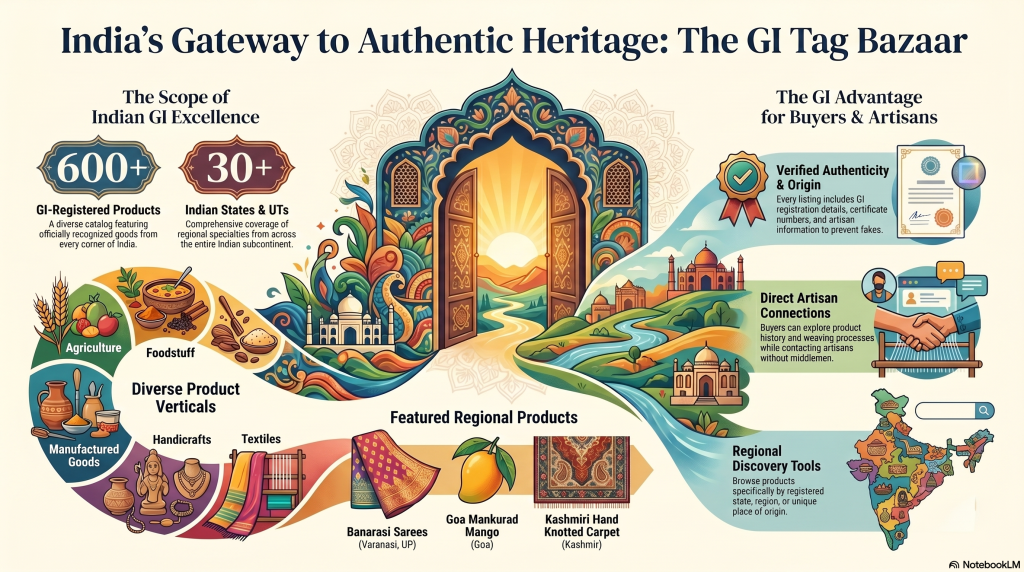
GI Tag Bazaar is India’s dedicated discovery platform for authenticated GI tagged products. Every product listed on our platform includes GI certification details, origin documentation, and verified seller information.
Browse by category:
- GI tagged agriculture products – Darjeeling Tea, Alphonso Mango, Basmati Rice, and 200+ more
- GI tagged handicraft products – Kashmiri Carpet, Blue Pottery, Madhubani Paintings, and 150+ more
- GI tagged textile products – Kanchipuram Silk, Chanderi Saree, Pochampally Ikat, and 120+ more
- GI tagged foodstuff products – Tirupati Laddu, Bikaneri Bhujia, Kashmir Kesar, and 60+ more
- GI tagged manufactured goods – Mysore Sandal Soap, Nashik Valley Wine, and 40+ more
Sources: Geographical Indications Registry (ipindia.gov.in), DPIIT Ministry of Commerce and Industry, World Intellectual Property Organization (wipo.int), TRIPS Agreement (WTO), Tea Board of India, Press Information Bureau (pib.gov.in)