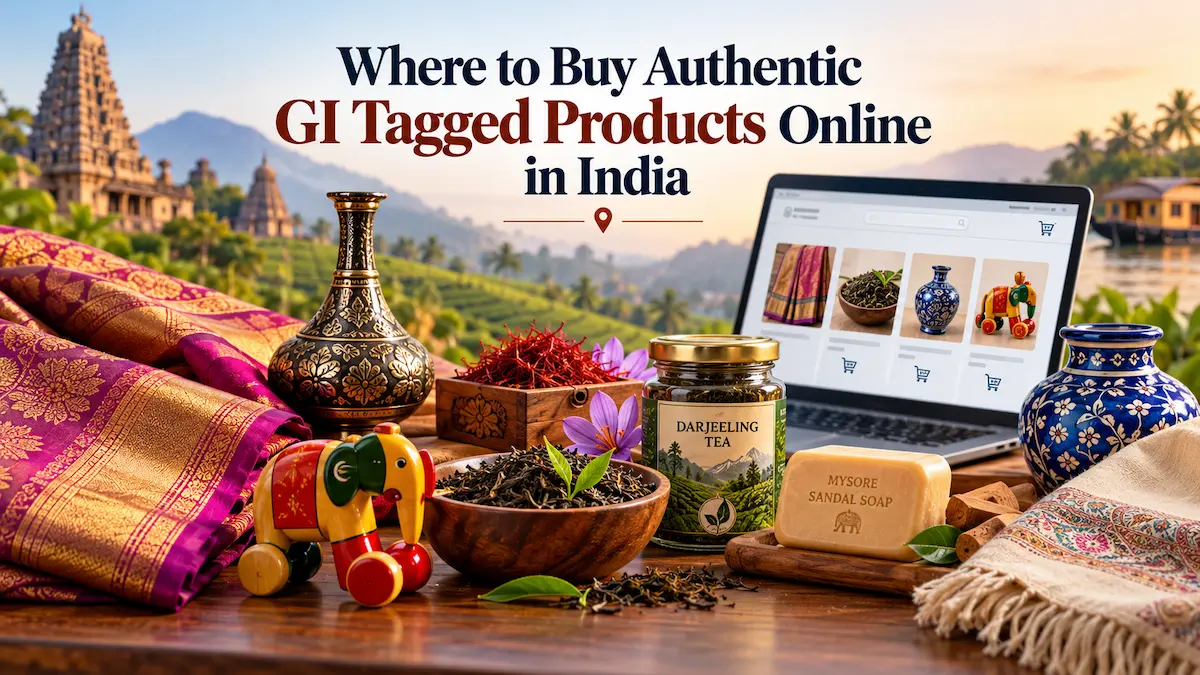
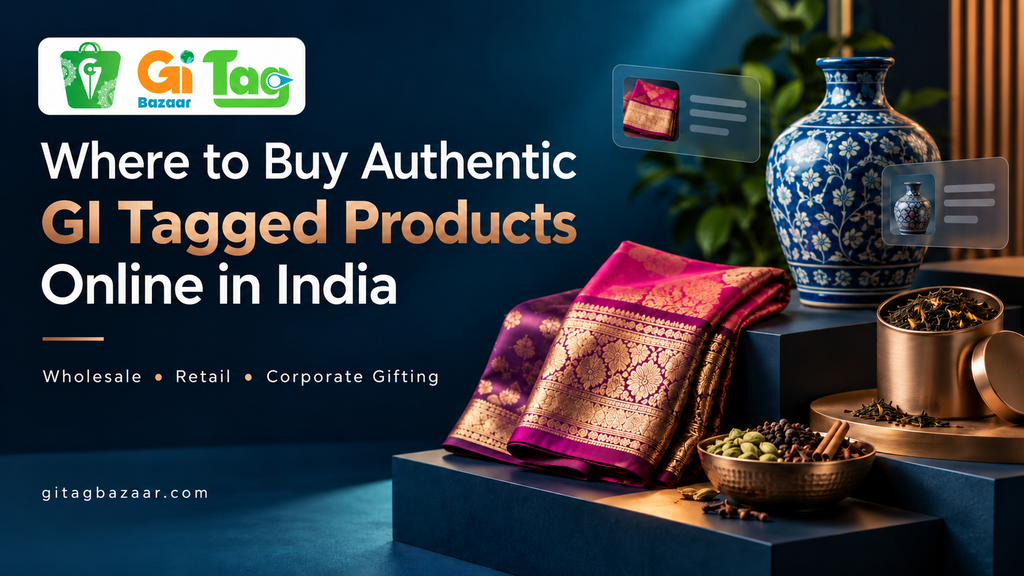
Where to Buy Authentic GI Tagged Products Online in India
Buyers can purchase authentic GI tagged products online through 6 verified channels: GI Tag Bazaar for product discovery, GiTAGGED for dedicated GI e-commerce, government emporiums like Cottage Emporium and Tribes India, Amazon and Flipkart GI storefronts, state cooperative platforms, and emerging government channels like ONDC and GeM. Each channel offers different product categories, verification levels, and pricing.
India has over 600 registered Geographical Indication products across 5 categories: agriculture, handicrafts, textiles, manufactured goods, and foodstuff. Understanding the meaning of Geographical Indication tag helps buyers recognize what origin certification protects and why it matters for product authenticity.
This guide covers every platform, category-wise buying recommendations, an 8-point authenticity verification checklist, and 7 red flags for identifying counterfeit GI products online.
What Are the Best Platforms to Buy GI Tagged Products Online?
The best platforms for buying GI tagged products online include GI Tag Bazaar for product discovery, GiTAGGED as a dedicated GI store with 180+ products, government emporiums (CCIC, Tribes India, KVIC), Amazon/Flipkart GI storefronts, state cooperatives, and ONDC/GeM as emerging channels.
6 buying channels serve different buyer needs. Dedicated GI platforms offer verified listings. Government emporiums provide origin-certified products. General marketplaces offer convenience with some GI seller storefronts. The comparison below covers each channel.
GI Tag Bazaar – India’s GI Product Discovery Marketplace
GI Tag Bazaar is a GI product discovery and listing marketplace that connects buyers with verified sellers across all 5 GI product categories. The platform lists products with verified region details, GI certificate numbers, and supplier information for each listing.
Buyers use GI Tag Bazaar to discover GI tagged products by category, state, and product type. The platform covers agriculture products, handicrafts, textiles, manufactured goods, and foodstuff items from registered GI regions across India.
Product listings display the GI registration number, authorized producer details, and the designated place of origin. This transparency helps buyers verify authenticity before purchasing from the listed sellers.
GiTAGGED – Dedicated GI Product Online Store
GiTAGGED (gitagged.com) operates as a dedicated e-commerce store for GI tagged products. The platform lists 180+ GI products sourced from artisans and producers across 23 states and 2 Union Territories.
Product categories on GiTAGGED include spices, teas, handloom textiles, handicrafts, and food items. The store also operates a seller storefront on Amazon India, providing an additional buying channel for the same products.
GiTAGGED claims direct sourcing from artisan communities. Buyers can verify product authenticity by cross-checking the GI registration details provided on each product page against the GI Registry database.
Government Emporiums and Online Stores
Government emporiums provide the highest authenticity assurance for GI tagged products because these outlets source directly from registered producers and artisanal communities.
5 government buying options are available:
- Central Cottage Industries Corporation (CCIC) is a government undertaking under the Ministry of Textiles. The online store at shoponline.cottageemporium.in sells GI certified handicrafts and handloom products. CCIC also operates a storefront on Amazon India.
- Tribes India is the retail outlet of TRIFED (Tribal Cooperative Marketing Development Federation of India). The platform sells tribal handicrafts, forest produce, and GI tagged tribal items through tribesindia.com and physical stores across India.
- Khadi and Village Industries Commission (KVIC) sells khadi textiles, village industry goods, and GI tagged khadi products through khadiindia.gov.in and Khadi Gramodyog Bhavan outlets.
- State handicraft emporiums operate in every state capital. Kerala’s Kairali, Rajasthan’s Rajasthali, and Karnataka’s Cauvery Emporium carry state-specific GI tagged handicrafts and textiles.
- GeM Aabhar Store on the Government e-Marketplace (GeM) sells ODOP (One District One Product) and GI tagged gift items sourced from CCIC, KVIC, and state emporiums. GeM Aabhar targets institutional and government buyers.
Amazon and Flipkart – GI Seller Storefronts
Amazon India hosts multiple GI-focused seller storefronts including GiTAGGED, CCIC (Cottage Emporium), and several state emporium stores. Buyers can find GI tagged products by searching for specific product names like “Darjeeling Tea GI tagged” or “Kanchipuram Silk Saree.”
Amazon does not operate a dedicated GI verification system. The responsibility for authenticity claims rests with individual sellers. Buyers need to check seller credentials, product descriptions for GI registration numbers, and customer reviews before purchasing.
Flipkart carries GI tagged products from various sellers. The same verification approach applies – check for GI registration details in the product listing and verify seller authorization through the GI Registry portal.
State Cooperative and Artisan Platforms
State cooperatives offer direct access to GI products from their place of origin. These organizations represent the artisan and producer communities that hold authorized user status under the GI Act 1999.
3 notable cooperative platforms include:
- KSIC (Karnataka Silk Industries Corporation) sells Mysore Silk sarees directly through ksicsilk.com. Every saree carries the GI tag, Silk Mark, and KSIC cooperative tag.
- Darjeeling Tea Association certifies and sells authentic Darjeeling Tea through its member estates. The Tea Board of India logo and GI tag appear on all authorized Darjeeling Tea packaging.
- Pochampally Ikat weavers’ cooperative in Telangana sells GI tagged Pochampally Ikat textiles directly to buyers through cooperative outlets and partner platforms.
Regional cooperatives provide the strongest origin verification because the cooperative itself holds authorized user registration in Part B of the GI Registry.
ONDC and GeM – Emerging Government Channels
ONDC (Open Network for Digital Commerce) is a government-backed open e-commerce network designed to connect buyers with local sellers, including artisans and GI product producers.
DPIIT (Department for Promotion of Industry and Internal Trade) and MSME Ministry signed a Memorandum of Understanding on 5 August 2026 to launch the “Bharat GI” initiative. This MoU aims to onboard GI tagged product sellers onto ONDC and GeM platforms, creating verified digital storefronts for registered GI producers.
GeM (Government e-Marketplace) already hosts the Aabhar store for GI and ODOP products. The Bharat GI initiative expands this programme by adding more GI product categories and producer communities to the platform.
ONDC and GeM are emerging channels. Product availability on these platforms is growing as more GI producers complete the digital onboarding process under the Bharat GI initiative.
How to Buy GI Tagged Products by Category?
Buying GI tagged products by category requires matching the product type with the right platform, checking category-specific certifications (Silk Mark for textiles, FSSAI for food, artisan cards for handicrafts), and verifying that the seller holds authorized user status for that specific GI product.
Each GI product category has distinct verification markers and preferred buying channels.
Where to Buy GI Tagged Textiles and Sarees Online
GI tagged textile products in India include Kanchipuram Silk, Banarasi Silk, Pochampally Ikat, Chanderi, Mysore Silk, and Pashmina. These products carry 3 verification markers: the GI tag, Silk Mark (for silk products), and Handloom Mark (for handwoven textiles).
Recommended buying channels for GI tagged textiles:
- Weaver cooperatives like KSIC (Mysore Silk) and state handloom corporations offer direct purchases with full origin documentation
- GI Tag Bazaar lists verified textile sellers with GI registration details
- Cottage Emporium (CCIC) stocks GI tagged handloom products at physical and online stores
- GiTAGGED carries handloom textiles from multiple GI regions
Best GI tagged sarees in India covers specific saree types, their origin districts, and price ranges for informed buying decisions.
Buyers purchasing GI tagged silk sarees need to check for both the GI logo and the Silk Mark holographic sticker. A handwoven saree also carries the Handloom Mark issued by the Development Commissioner (Handlooms).
Where to Buy GI Tagged Food and Agriculture Products Online
GI tagged agriculture products in India include Darjeeling Tea, Alphonso Mango, Kashmir Saffron, Banaganapalle Mango, Naga Mircha (King Chilli), and Coorg Orange. These products require FSSAI compliance alongside GI certification.
Recommended buying channels for GI tagged food and agriculture products:
- Producer cooperatives sell seasonal products directly during harvest windows (Alphonso Mango: March to June, Darjeeling Tea: first flush March to April)
- GiTAGGED carries GI tagged spices, teas, and food products year-round
- GI Tag Bazaar lists food product sellers with verified origin and FSSAI details
- Amazon hosts seller storefronts for popular GI food products like Darjeeling Tea and Kashmir Saffron
FSSAI license verification is mandatory for all packaged GI tagged food products. Buyers can check the 14-digit FSSAI license number on the FSSAI website (fssai.gov.in) before purchasing.
Where to Buy GI Tagged Handicrafts Online
GI tagged handicraft products in India include Bidriware from Bidar (Karnataka), Channapatna Toys from Karnataka, Blue Pottery from Jaipur, and Dhokra metal craft from West Bengal. Handicraft verification relies on artisan authentication cards and cooperative certificates.
Recommended buying channels for GI tagged handicrafts:
- Government emporiums (Cottage Emporium, state handicraft emporia) source directly from registered artisans and issue origin certificates
- Tribes India (TRIFED) sells tribal GI tagged handicrafts with heritage documentation
- GI Tag Bazaar lists handicraft sellers with artisan details and GI certification
- GiTAGGED carries handicraft items from multiple regions
Handicraft purchases require extra verification. Buyers need to confirm the specific origin district (Bidriware from Bidar, not from other locations) and check for artisan cooperative tags on the product.
Where to Buy GI Tagged Manufactured Goods and Foodstuff Online
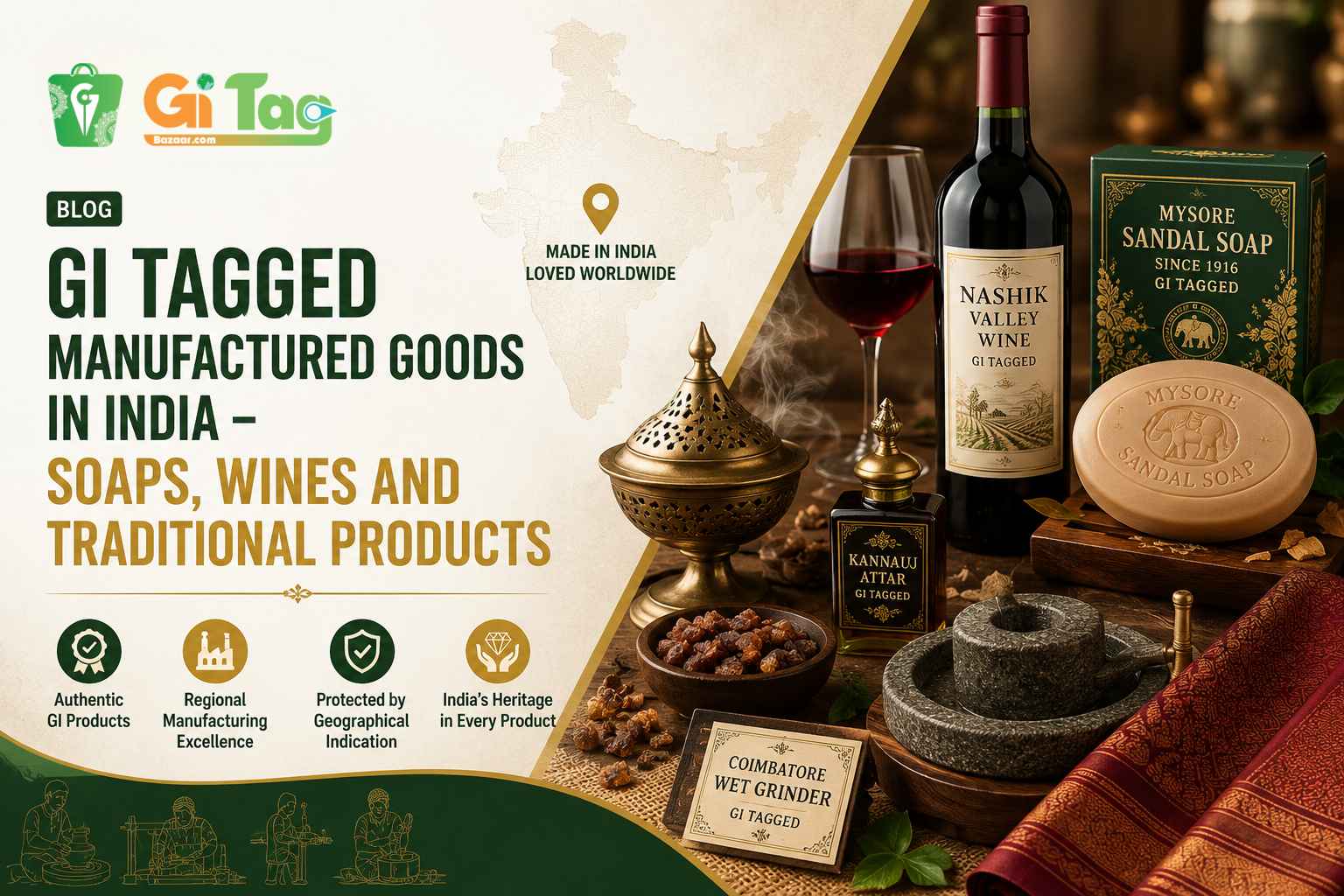
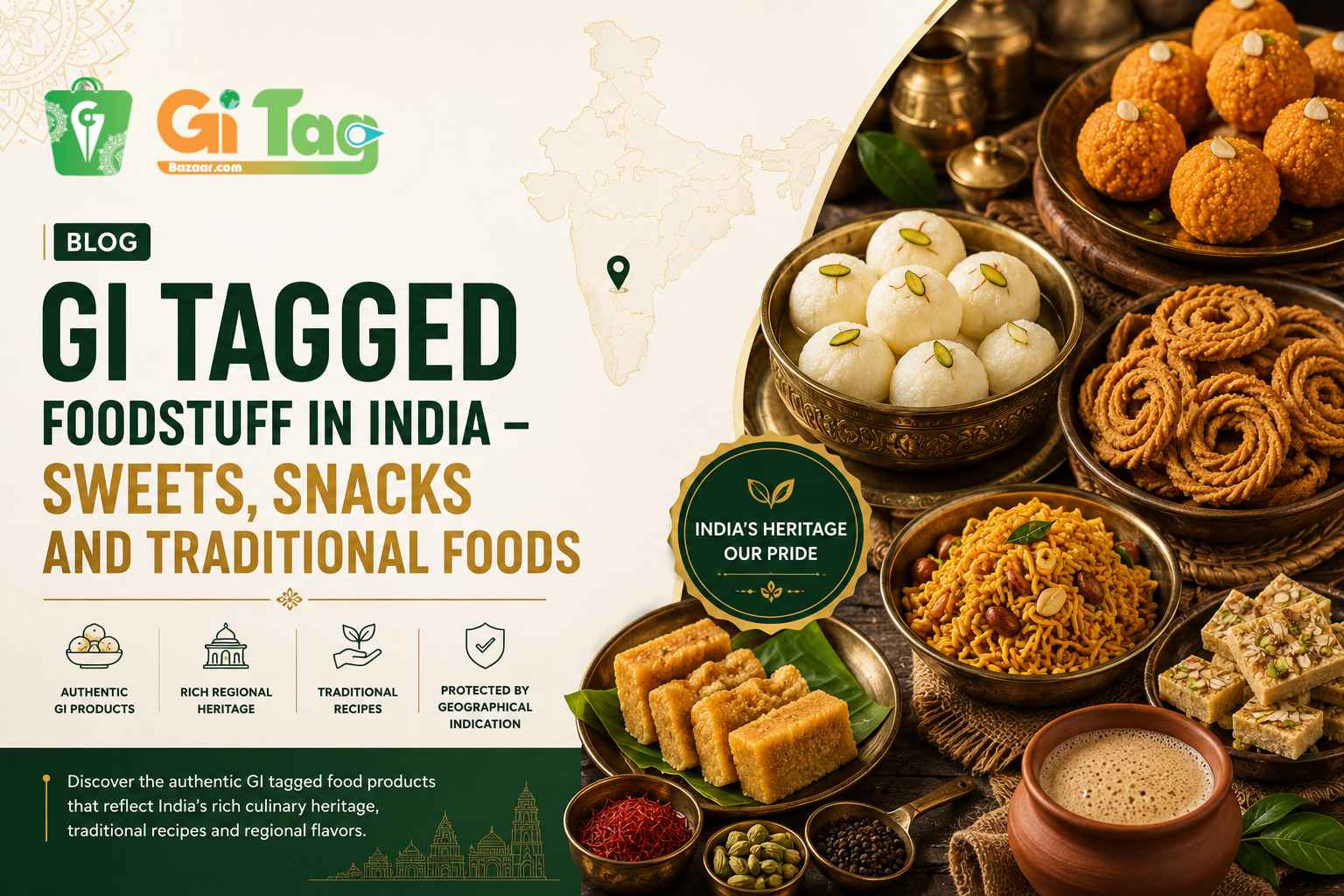
GI tagged manufactured goods in India include Mysore Agarbathi, Kannauj Perfume, and Mysore Sandal Soap. GI tagged foodstuff products in India include processed food items like Tirupathi Laddu, Dharwad Pedha, and Ratlami Sev.
Manufactured goods and foodstuff products often carry BIS (Bureau of Indian Standards) certification alongside the GI tag. Mysore Sandal Soap carries both GI registration and BIS quality marks, manufactured exclusively by KSDL (Karnataka Soaps and Detergents Limited).
Buyers can purchase these products through the manufacturer’s official website, government emporiums, and verified sellers on GI Tag Bazaar and GiTAGGED.
How to Verify Authenticity Before Buying GI Products Online?
Buyers can verify GI product authenticity online through 8 checks: GI Registry database search, authorized user verification, GI logo presence, certificate number cross-check, complementary certification (Silk Mark, FSSAI), origin district confirmation, seller documentation review, and price range validation.
Complete this 8-point checklist before purchasing any GI tagged product online:
- Search the GI Registry database. Open the GI Registry public portal at search.ipindia.gov.in/GIRPublic/ and confirm the product name appears in Part A of the registered GI list.
- Verify seller authorization in Part B. Check Part B of the GI Registry to confirm the seller or producer holds authorized user status for that specific GI product. Only authorized users registered through Form GI-3 hold the legal right to sell products under a GI tag.
- Look for the official GI logo. The tricolour GI logo launched in 2018 by the Ministry of Commerce and Industry carries the tagline “Invaluable Treasures of Incredible India.” Product images and packaging must display this logo.
- Cross-check the GI certificate number. The product listing must mention the GI registration number. Match this number against the Part A records on the GI Registry portal.
- Check complementary certifications. Silk products need Silk Mark. Food products need FSSAI license. Handloom products need Handloom Mark. Missing complementary marks indicate incomplete verification.
- Confirm the origin district. The seller must name the specific place of origin. “Kashmir Pashmina” comes from Jammu and Kashmir only. “Kanchipuram Silk” comes from Kanchipuram, Tamil Nadu only.
- Review seller documentation. Legitimate sellers provide artisan details, cooperative membership, or producer association affiliation. Request these details before purchasing.
- Validate the price range. GI tagged products carry premium pricing because of origin certification and traditional production methods. Prices far below the category average signal counterfeit products.
The detailed process for verifying GI tag authenticity online covers each verification method with step-by-step instructions and examples across all 5 product categories.
What Are the Red Flags When Buying GI Products Online?
Counterfeit GI products display 7 red flags: missing GI registration number, vague origin claims, prices far below market rate, “inspired by” marketing language, stock product photos, absent seller credentials, and missing complementary certifications.
7 red flags to identify fake GI tagged products online:
- No GI registration number in the listing. Every genuine GI product references its registration number from Part A of the GI Registry. A seller who does not display this number is not providing verifiable authenticity proof.
- Vague origin claims. “Handcrafted in India” or “from the foothills” does not equal a GI claim. Genuine sellers name the specific district: “woven in Kanchipuram, Tamil Nadu” or “grown in Darjeeling district, West Bengal.”
- Price far below market rate. A Kanchipuram Silk Saree costs Rs 5,000 to Rs 50,000 depending on zari content and silk quality. A listing at Rs 500 for a “Kanchipuram Silk Saree” is not a genuine GI product. Kashmir Saffron retails at Rs 2,00,000 to Rs 3,00,000 per kilogram. Saffron priced at Rs 500 per gram (Rs 5,00,000 per kg) or Rs 50 per gram (Rs 50,000 per kg) needs careful origin verification.
- “Inspired by” or “in the style of” language. These phrases signal imitation products. “Banarasi style saree” and “Banarasi Silk Saree with GI tag” are fundamentally different products with different legal protections.
- Stock photos instead of actual product images. Genuine sellers display real product photos showing the GI logo, packaging labels, and certificate details. Generic lifestyle images without product-specific markers indicate low verification standards.
- Seller cannot provide authorized user details. A legitimate GI product seller holds authorized user registration or sources from registered producers. Request Part B registration details before purchasing.
- Missing complementary certifications. A GI tagged silk product without Silk Mark, or a GI tagged food product without FSSAI license, lacks the complementary verification that authenticated products carry.
How to Buy GI Tagged Products from Outside India?
NRI buyers and international customers can purchase GI tagged products through platforms that offer international shipping: GiTAGGED ships to select countries, Tribes India offers international delivery for tribal handicrafts, and Amazon India’s global shipping programme covers select GI products.
3 buying options serve international buyers:
- GiTAGGED international shipping. The platform ships GI tagged products to select countries. International orders typically include premium packaging with authenticity documentation. Shipping costs and delivery timelines vary by destination country.
- Tribes India international delivery. TRIFED ships tribal handicrafts and GI tagged products internationally through its website. Government-backed sourcing provides authenticity assurance for international buyers.
- Amazon Global shipping. Select GI tagged products from Amazon India are available through Amazon’s international shipping programme. Buyers outside India can filter for products eligible for global delivery.
International buyers face additional considerations. Customs duties apply based on the destination country’s import regulations. Food and agriculture GI products (spices, tea, saffron) require phytosanitary certificates for customs clearance in most countries. Textile products (silk sarees, pashmina shawls) attract textile import duties in many destination countries.
Premium packaging with tamper-proof sealing and enclosed authenticity certificates protects GI products during international transit. Buyers can request sellers to include GI registration documentation with the shipment for customs verification purposes.
How to Buy GI Tagged Products for Corporate and Bulk Gifting?
Corporate buyers can source GI tagged products for gifting through government emporiums (GeM Aabhar Store, Cottage Emporium), producer cooperatives for direct bulk procurement, and dedicated gifting platforms that curate GI product hampers with customized packaging.
3 corporate buying channels are available:
- GeM Aabhar Store is designed for government and institutional buyers. The platform offers bulk ordering for GI tagged and ODOP gift items sourced from CCIC, KVIC, and state emporiums.
- Direct cooperative procurement. Producer cooperatives (KSIC for Mysore Silk, state tea boards for Darjeeling Tea, artisan cooperatives for handicrafts) offer bulk pricing for corporate orders placed directly with the cooperative.
- Curated gifting platforms. Platforms like GI Tag Bazaar and GiTAGGED offer GI product hampers combining products from multiple categories. Customized packaging with corporate branding is available for bulk orders.
The guide on best GI tagged gifts from India covers top gifting options by price range and occasion. GI tagged products for corporate gifting details bulk procurement processes, MOQ (Minimum Order Quantity) requirements, and lead times for corporate orders.
GI tagged products serve as heritage gifts that carry origin certification and cultural significance. Corporate gifting with GI products supports artisan livelihoods and promotes India’s traditional crafts and agriculture.
Buying authentic GI tagged products online requires matching the right platform to the product category, verifying seller authorization through the GI Registry, and checking category-specific certifications. The 8-point verification checklist and 7 red flags provide a systematic approach to avoid counterfeit products across all buying channels.
Frequently Asked Questions About Buying GI Tagged Products
Are GI Tagged Products More Expensive Than Regular Products?
Yes. GI tagged products carry premium pricing because origin certification, traditional production methods, and limited geographical sourcing increase production costs compared to mass-produced alternatives. A GI tagged Kanchipuram Silk Saree costs Rs 5,000 to Rs 50,000 because of pure mulberry silk, real zari, and handloom weaving in Kanchipuram. A machine-made imitation costs Rs 500 to Rs 2,000. The premium reflects authenticity, heritage, and the artisan’s skilled labour. Price premiums vary by category – GI tagged Darjeeling Tea costs 2 to 5 times more than regular Assam tea, while GI tagged Alphonso Mangoes cost 3 to 4 times more than non-GI mango varieties.
Can GI Tagged Products Be Returned or Exchanged?
Yes. Return and exchange policies for GI tagged products depend on the selling platform’s policy, not on the GI certification itself, because GI registration governs origin and production standards, not commercial terms. Amazon, Flipkart, and other e-commerce platforms apply their standard return policies to GI tagged products. Government emporiums like Cottage Emporium and Tribes India have their own return policies displayed at the point of sale. Direct purchases from artisan cooperatives follow the cooperative’s terms. Buyers need to check the specific platform’s return policy before purchasing, especially for perishable GI food products (mangoes, tea, spices) where return windows are shorter.
Does Every GI Tagged Product Come with a Certificate?
No. A GI registration certificate is issued to the registered proprietor (producer association), not to individual product units, so individual products carry the GI logo and registration number rather than a separate certificate per item. Authorized users registered in Part B of the GI Registry can display the GI tag, GI logo, and registration number on their products. Some premium GI products include a certificate of authenticity from the producer cooperative (KSIC for Mysore Silk, Tea Board of India for Darjeeling Tea). Buyers can verify any GI product’s registration status through the GI Registry public portal at search.ipindia.gov.in/GIRPublic/ using the registration number displayed on the product packaging.
Which GI Tagged Products Are Best for Gifting?
Darjeeling Tea, Kanchipuram Silk Sarees, Kashmir Pashmina shawls, Mysore Sandal Soap, and Channapatna Toys are among the most popular GI tagged products for gifting because they combine heritage value, origin certification, and practical use across multiple price ranges. Gifting price ranges start at Rs 200 to Rs 500 for Channapatna Toys and Mysore Sandal Soap, Rs 500 to Rs 2,000 for premium Darjeeling Tea and Kashmir Saffron, and Rs 5,000 to Rs 50,000 for Kanchipuram Silk Sarees and Kashmir Pashmina. The complete guide on best GI tagged gifts from India covers 20+ gifting options organized by occasion and budget.
How to Report a Seller Selling Fake GI Products Online?
Buyers can report fake GI product sellers to the GI Registry in Chennai, the registered proprietor of the GI, the e-commerce platform’s seller complaint mechanism, or consumer protection forums under the Consumer Protection Act 2019. The GI Act 1999 treats unauthorized use of a registered GI as infringement under Sections 21 and 22. Complaints can be filed with the registered proprietor (the producer association holding GI registration), the CGPDTM (Controller General of Patents, Designs and Trade Marks) office, or the National Consumer Helpline at 1800-11-4000. E-commerce platforms like Amazon and Flipkart also accept intellectual property infringement reports from GI registered proprietors against unauthorized sellers.