
GI Act 1999 Explained: Registration, Rights and Protection of Indian Heritage Products
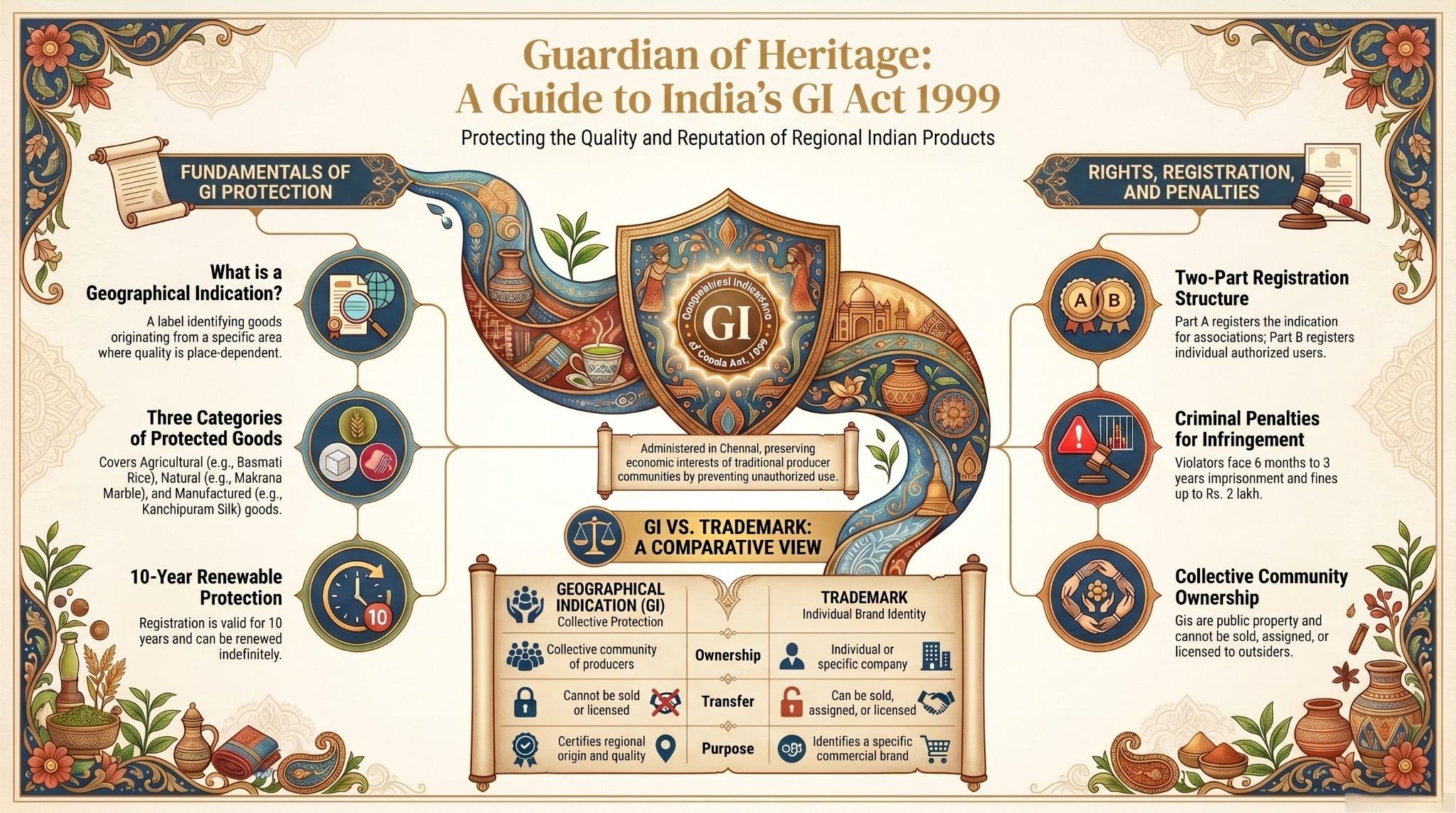
The Geographical Indications of Goods (Registration and Protection) Act, 1999 is an Indian law that registers and protects products whose quality, reputation, or characteristics are linked to a specific geographical origin. It came into force in 2003, created the GI Registry in Chennai, and gave India a dedicated intellectual property system to protect products like Darjeeling Tea, Banarasi Saree, and Kashmir Pashmina from unauthorized use.
Quick Summary
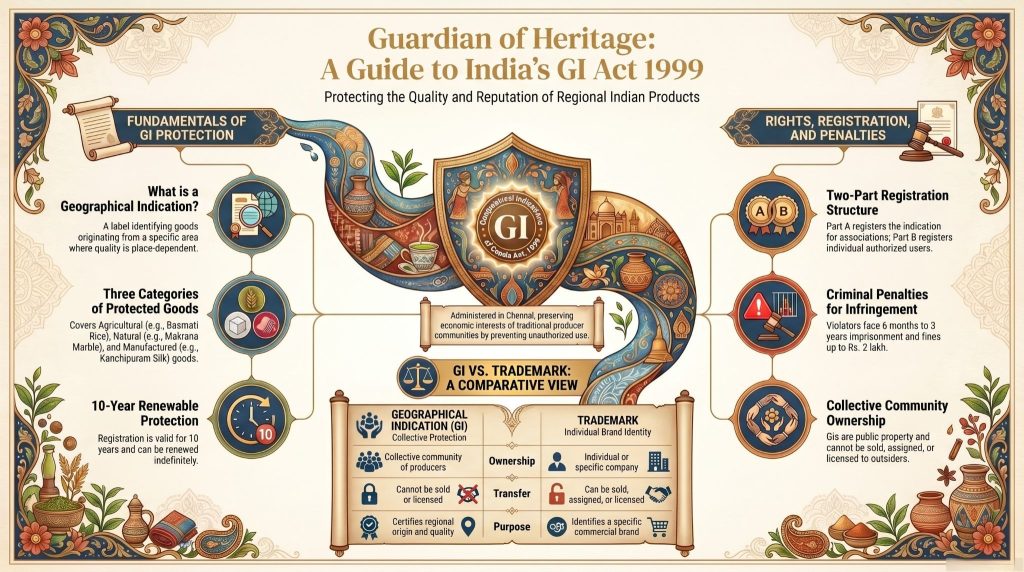
| What You Want to Know | The Answer |
|---|---|
| What the Act protects | Products whose quality is tied to a specific place of origin |
| When it came into force | 2003 (passed in 1999) |
| Where the GI Registry is | Chennai, Tamil Nadu |
| Who can apply | Associations or organizations representing producers |
| Registration validity | 10 years, renewable indefinitely |
| Penalty for infringement | 6 months to 3 years imprisonment + fine up to Rs. 2 lakh |
| Legal framework | Sui generis system, aligned with WTO TRIPS Agreement |
What is a Geographical Indication (GI)?
A Geographical Indication (GI) is a sign or label on goods that identifies their origin from a specific geographical area, where the quality, reputation, or other characteristics of the goods are essentially due to that place. Darjeeling Tea was the first product to receive a GI tag in India in 2004.
The legal definition comes from Section 2(1)(e) of the Geographical Indications of Goods (Registration and Protection) Act, 1999. This definition has three requirements. First, there must be an indication identifying a geographic origin. Second, the goods must come from that specific territory, region, or locality. Third, the quality, reputation, or characteristics of the goods must be essentially attributable to that geographical origin.
Types of Goods Covered Under GI
The GI Act covers three categories of goods:
Agricultural goods include products that grow in specific regions due to soil, climate, or elevation. Basmati Rice, Darjeeling Tea, Alphonso Mango, and Naga Mircha (Bhut Jolokia) are registered agricultural GI products.
Natural goods include materials that originate from a specific geography and cannot be replicated elsewhere. Makrana Marble from Rajasthan is a registered natural GI.
Manufactured goods include products made using traditional processes specific to a region. Banarasi Saree, Kanchipuram Silk, and Mysore Sandal Soap are registered manufactured GI products.
Why Did India Need the GI Act?
India needed the GI Act to protect traditional producers from commercial exploitation, stop consumer deception by fake products, and create a legal basis for promoting Indian heritage goods in international markets. Before 1999, no specific Indian law protected geographical indications.
The GI Act was introduced primarily to comply with Article 22 of the TRIPS Agreement (Trade-Related Aspects of Intellectual Property Rights) under the World Trade Organization. India ratified the TRIPS Agreement in 1995 as part of joining the WTO. Article 22 of TRIPS requires all member countries to provide legal means for interested parties to prevent the misleading use of geographical indications.
Core Objectives of the GI Act
The Geographical Indications of Goods Act serves three objectives:
- Protect producers from unauthorized use — Only registered proprietors and authorized users can use a GI tag legally. Unauthorized use is a criminal offence.
- Prevent consumer deception — GI registration stops sellers from passing off goods from other regions as genuine GI products. A buyer paying for Darjeeling Tea has the right to receive tea from Darjeeling’s estates.
- Promote GI products in export markets — Registered GI products get legal recognition in countries that have bilateral agreements with India, making it easier to stop foreign sellers from misusing Indian product names.
What are the Key Features of the GI Act 1999?
The GI Act 1999 establishes a registration system, creates a GI Registry, grants exclusive rights to registered users, prohibits assignment or licensing of GI tags, and provides criminal penalties for infringement.
The Act establishes a two-part registration structure:
Part A Registration covers registration of the geographical indication itself. Only an association of persons, producers, or an organization established by law can register a GI under Part A. The Darjeeling Tea Association, for example, holds the Part A registration for Darjeeling Tea.
Part B Registration covers registration of authorized users. Individual producers who are members of the registered association apply under Part B to use the GI tag on their products.
Key legal characteristics of a GI under the Act:
- A GI belongs to the community of producers in that region. It is public property.
- A GI cannot be assigned, transferred, or licensed to any person outside the registered region.
- A GI cannot be registered as a trademark by any private entity.
- The GI Registry maintains a Register of Geographical Indications that is open to public inspection.
How Does the GI Registration Process Work?
The GI registration process in India involves filing an application with the GI Registry in Chennai, undergoing scrutiny, publication in the GI Journal, a three-month opposition period, and final registration with a certificate. The entire process typically takes 12 to 18 months.
Who Can Apply for GI Registration?
The following entities can apply for GI registration under Part A:
- Associations of persons or producers — A group of producers or farmers who collectively produce the GI product in the defined region.
- Organizations or authorities established by law or statute representing the interests of producers.
- Central or state government bodies responsible for the product’s regulation or promotion.
Individual producers cannot apply for Part A registration. They can only apply for Part B (authorized user status) after the GI is registered under Part A by their association.
Step by Step Registration Process
- File the application with the Registrar of Geographical Indications, Chennai. The application must be filed in the prescribed form.
- Preliminary scrutiny by the Registrar to check completeness and compliance.
- Examination by the Registrar who may raise objections. The applicant responds within two months.
- Publication in the GI Journal once accepted. The journal is published weekly by the GI Registry.
- Opposition period of three months from the date of publication. Any person can file a notice of opposition.
- Registration and certificate issued if no opposition is received or if opposition is decided in favor of the applicant.
Required Documents for Application
| Document | Purpose |
|---|---|
| Statement of case | Explains why the product deserves GI status |
| Description of goods | Detailed description of the product and its characteristics |
| Proof of geographical origin | Evidence that the product comes from the claimed region |
| Map of the region | Defined territorial boundaries of the production area |
| List of producers | Names and addresses of current producers in the region |
| Inspection structure | Details of how quality will be monitored |
| Standards for production | Description of traditional or standard production processes |
Is GI Registration Permanent?
No. GI registration is not permanent. A registered geographical indication is valid for 10 years from the date of registration. It can be renewed indefinitely for additional 10-year periods upon payment of the renewal fee. An authorized user registration is also valid for 10 years and renewable.
If the registration lapses without renewal, the geographical indication loses legal protection. During the lapse period, the GI cannot be restored by the original applicant without filing a fresh application. The Registrar can remove a GI from the register for non-renewal after notifying the registered proprietor.
What Cannot Be Registered as a GI?
Section 9 of the GI Act lists goods that cannot be registered as geographical indications even if they originate from a specific region. The Registrar must refuse registration in these cases:
- Indications likely to cause confusion or deception about the true place of origin of goods.
- Generic names — Names that have become common in everyday language as the common designation of goods. If a product name has become a common noun, it cannot be registered as a GI.
- Indications against public order or morality — Names or signs that are offensive or contrary to public morality.
- Indications that hurt religious sentiments — Signs or words that might offend religious groups.
- Indications that are false as to the nature, quality, or geographical origin of the goods.
- Indications protected under the Paris Convention for the Protection of Industrial Property where registration would be against the principles of that convention.
What Counts as GI Infringement and What are the Penalties?
GI infringement is the unauthorized use of a registered geographical indication on goods that do not originate from the protected region, or using a false indication that misleads consumers about a product’s geographical origin. The GI Act treats infringement as a criminal offence, not just a civil matter.
Acts That Constitute GI Infringement
- Using a registered GI on goods that did not originate from the registered region.
- Imitating a GI label in a way that misleads consumers about the origin.
- Applying a false geographical indication on goods for the purpose of trade.
- Passing off goods as GI-tagged when they are not from the protected region.
- Selling, distributing, or stocking goods with a false GI label for commercial purposes.
Penalties Under the GI Act
| Offence | Minimum Penalty | Maximum Penalty |
|---|---|---|
| Applying a false GI | 6 months imprisonment | 3 years imprisonment |
| Fine for false GI use | Rs. 50,000 | Rs. 2,00,000 |
| Selling goods with false GI | 6 months imprisonment | 3 years imprisonment |
| Repeat offence | 1 year imprisonment | 3 years imprisonment + higher fine |
Courts in India have jurisdiction to try GI infringement cases. The aggrieved registered proprietor or authorized user can also pursue civil remedies including injunctions, damages, and seizure of infringing goods.
A real-world example of GI infringement risk: Darjeeling Tea faced significant misuse internationally for decades before receiving international GI protection. Tea labeled as “Darjeeling” was sold in several countries despite containing no tea from Darjeeling’s estates. The Tea Board of India has pursued legal action in multiple countries under their respective IP laws.
Who are the Key Stakeholders Under the GI Act?
The GI Act defines two primary stakeholders: the Registered Proprietor and the Authorized User. Both have distinct roles and different legal rights.
| Stakeholder | Who They Are | Legal Rights |
|---|---|---|
| Registered Proprietor | The association, organization, or authority that registers the GI under Part A | Owns the GI registration; can take legal action for infringement; can grant authorized user status |
| Authorized User | An individual producer registered under Part B who is permitted to use the GI | Can use the GI on their qualifying products; can also take legal action for infringement |
| GI Registrar | Government officer at the GI Registry, Chennai | Administers the registration process; maintains the GI Register; handles oppositions |
| Controller General of Patents, Designs and Trade Marks | Supervises GI Registry operations | Appellate authority for decisions of the GI Registrar |
The Registered Proprietor cannot sell, transfer, or assign the GI to another entity. This is fundamentally different from trademarks, which can be bought and sold.
How Does India’s GI Law Fit into the Global Context?
India’s GI Act 1999 operates as part of the international intellectual property framework governed by the TRIPS Agreement under the World Trade Organization. India is a member of WTO and bound by the minimum standards TRIPS sets for GI protection.
The TRIPS Agreement has two levels of protection:
Standard protection (Article 22) applies to all geographical indications. It requires countries to provide legal means to prevent GI misuse and false indications of origin. India’s GI Act fulfils this requirement.
Enhanced protection (Article 23) applies specifically to wines and spirits. Under this provision, even true geographical indications for wines and spirits are protected from use by unauthorized persons, regardless of whether consumer deception is involved. India’s GI Act provides enhanced protection to all categories of goods, not just wines and spirits, which is more comprehensive than what TRIPS requires.
India also participates in discussions through the World Intellectual Property Organization (WIPO) on extending enhanced TRIPS protection to other categories of GI products. This is relevant to Indian products like Basmati Rice, which have faced foreign registration attempts.
Why is the GI Act Important for India?
The GI Act is important for India because it protects the economic interests of rural producers, preserves traditional knowledge and heritage craftsmanship, and builds India’s brand credibility in global export markets.
Economic and Cultural Impact
Economic impact:
- GI tags add price premium potential for producers. Darjeeling Tea with a GI label commands significantly higher prices than non-GI teas in European markets.
- GI protection prevents revenue losses from counterfeit products. Fake Banarasi Sarees sold in Indian markets reduce earnings for genuine weavers in Varanasi.
- GI products support artisan and farmer communities in rural areas. India had over 500 registered GI tags as of 2024, spanning agriculture, textiles, handicrafts, and foodstuff.
Cultural impact:
- GI registration documents and preserves traditional knowledge that would otherwise exist only in oral traditions.
- The registration process formally defines production boundaries and processes, creating a legal record of cultural heritage.
- GI-tagged products become ambassadors of regional identity in international markets.
What are the Challenges Facing the GI Act?
The GI Act faces three practical challenges: low awareness among eligible producers, weak enforcement on the ground, and limited international recognition for Indian GI products in countries without bilateral IP agreements.
Awareness gap: Many producer communities eligible for GI protection do not know the registration process exists. Small artisan groups and individual farmers in remote regions rarely have access to legal information or financial resources to file GI applications.
Enforcement gap: After registration, enforcement depends on producers and their associations filing complaints. Government enforcement resources for IP violations are limited. Counterfeit GI products continue to circulate in markets.
International recognition gap: India’s GI registrations are valid within India. In other countries, GI protection depends on that country’s domestic laws and bilateral agreements with India. This is why Basmati Rice has been registered under the GI tag in India, but foreign producers in some countries have attempted to use the “Basmati” name without restriction.
How is a Geographical Indication Different from a Trademark?
A Geographical Indication protects the collective identity of producers in a specific region, while a trademark protects the brand identity of an individual company or person. These are fundamentally different forms of intellectual property.
| Basis of Comparison | Geographical Indication | Trademark |
|---|---|---|
| Ownership | Collective — belongs to all qualifying producers in the region | Individual or company-owned |
| Transfer | Cannot be assigned, sold, or licensed to outsiders | Can be assigned, sold, and licensed |
| Purpose | Certifies geographical origin and quality | Identifies commercial brand source |
| Duration | 10 years, renewable indefinitely | 10 years, renewable indefinitely |
| Who can use it | Any authorized user from the registered region | Only the trademark owner or their licensee |
| Legal basis | GI Act 1999 | Trade Marks Act 1999 |
| Protection scope | A region’s entire producer community | A single brand entity |
A GI and a trademark can coexist. The Darjeeling Tea Association holds a GI registration for Darjeeling Tea. Individual tea brands within Darjeeling can also register their specific brand names as trademarks. The GI protects the regional identity; the trademark protects the individual brand.
Frequently Asked Questions About the GI Act
What is the GI Act 1999? The GI Act 1999 is the Geographical Indications of Goods (Registration and Protection) Act, 1999. It is an Indian law that registers and protects geographical indications — signs identifying goods from specific regions where quality is tied to geographical origin. The Act came into force in 2003.
Who administers the GI Act in India? The Geographical Indications Registry, located in Chennai, administers the GI Act. The Registry operates under the Controller General of Patents, Designs and Trade Marks, which is part of the Department for Promotion of Industry and Internal Trade (DPIIT) under the Ministry of Commerce and Industry.
Can an individual producer register a GI tag? No. Individual producers cannot register a geographical indication under Part A. Only associations of persons, producers, or organizations established by law representing producers can apply for Part A registration. Individual producers can register as authorized users under Part B after the GI is registered.
Is a GI tag renewable after 10 years? Yes. A GI registration is valid for 10 years from the date of registration and can be renewed for additional 10-year periods by paying the prescribed renewal fee. There is no maximum number of renewals — a GI can remain registered indefinitely with timely renewals.
What is the difference between a registered proprietor and an authorized user? The registered proprietor is the organization that owns the GI registration under Part A. The authorized user is an individual producer registered under Part B who has the right to use the GI tag on qualifying products. Both the registered proprietor and authorized users can take legal action against GI infringement.
The GI Act and gitagbazaar.com: What Buyers and Sellers Should Know
The GI Act creates legal rights for producers, but it also protects buyers. A product carrying an authentic GI label has been produced by a registered authorized user within the defined geographical area, following documented production standards.
When you buy a GI-tagged product from a verified source, the GI Act guarantees that:
- The product originates from the registered geographical region.
- The producer is an authorized user registered with the GI Registry.
- The quality attributes linked to that region are present in the product.
Sellers listing GI-tagged products are legally required to be authorized users. Misrepresenting a non-GI product as GI-tagged constitutes infringement under the Act and attracts criminal penalties.
For more on the registration process, read the full guide on GI Tag Registration Process in India. To understand how GI differs from trademark and patent protection, see GI Tag vs Trademark vs Patent. To discover GI-tagged products by category, visit the Complete List of GI Tagged Products in India.