

How GI Tag Registration Works in India | Complete Guide
GI tag registration in India follows a 7-stage legal process governed by the Geographical Indications of Goods (Registration and Protection) Act, 1999. The process starts with filing Form GI-1, passes through examination and public opposition, and ends with a certificate of registration issued by the Geographical Indications Registry in Chennai. The full process typically takes 1 to 2 years.
Quick Facts: GI Tag Registration at a Glance
| Detail | Value |
|---|---|
| Governing Law | GI of Goods Act, 1999 and GI Rules, 2002 |
| Administering Authority | Geographical Indications Registry, Chennai |
| Application Form | Form GI-1 (Parts A to D) |
| Who Can Apply | Associations, producer groups, NGOs, statutory bodies |
| Ownership Type | Collective (not individual or company) |
| Validity Period | 10 years, renewable indefinitely |
| Typical Timeline | 1 to 2 years from filing to certification |
| Acceptance Rate | Around 46% |
What is a GI Tag in India?
A GI tag is a sign given to goods that originate from a specific geographical region and carry qualities, reputation, or characteristics linked to that region. It is a legal form of intellectual property protection under Indian and international law.

India introduced GI tags through the Geographical Indications of Goods (Registration and Protection) Act, 1999. This law was passed to comply with the TRIPS Agreement under the World Trade Organization. The law protects producer interests, prevents fraud, and promotes exports of Indian origin goods.
Examples of Indian GI Tagged Products
Three well-known GI tagged products in India are Darjeeling Tea, Basmati Rice, and Kanchipuram Sarees. Each of these products is linked to a specific geography and carries qualities that cannot be replicated elsewhere.
GI tags cover three categories of goods:
- Agricultural goods
- Natural goods
- Manufactured goods
Who Can Apply for a GI Tag?
Any association of persons, producer group, organization, or statutory body that represents the producers of a region can apply for a GI tag. Individual producers cannot hold a GI registration.
GI ownership is always collective. This is a fundamental difference from a trademark, which can be held by an individual or company. The applicant must prove through an affidavit that it legitimately represents the producers of the tagged product.
Eligible applicants include:
- Associations of persons or producers
- Producer cooperatives
- NGOs working in the region
- State or central statutory bodies
What Are the Eligibility Criteria for GI Registration?
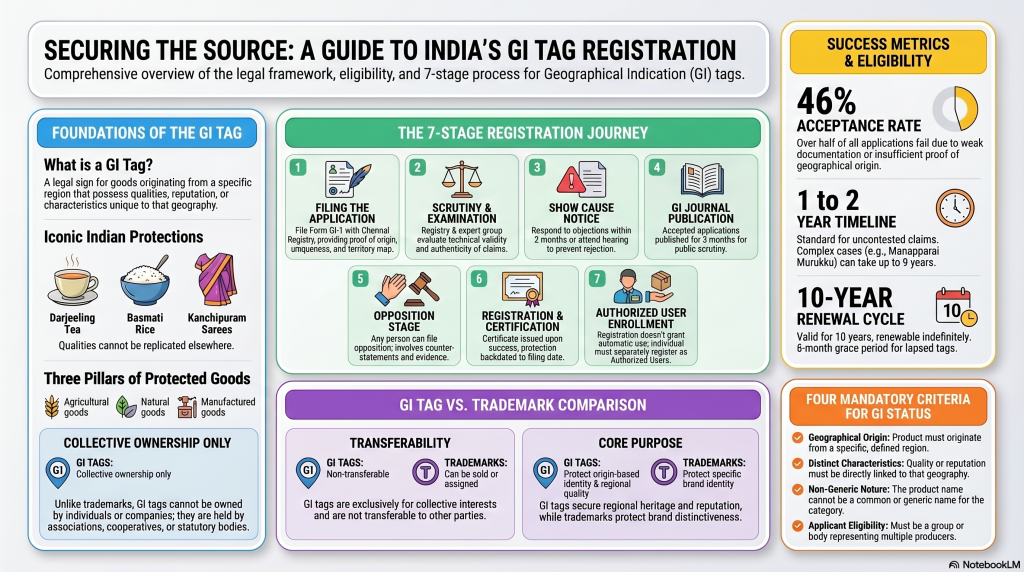
A product must meet 4 criteria before the Geographical Indications Registry will accept an application.
| Criterion | Requirement |
|---|---|
| Geographical Origin | Product must originate from a specific defined region |
| Distinct Characteristics | Quality or reputation must be directly linked to that geography |
| Non-Generic Nature | Product name must not be a common or generic name |
| Applicant Eligibility | Applicant must be a group or body representing producers |
A product that fails even one criterion faces rejection. The 46% acceptance rate in India reflects how strictly the Registry applies these filters.
What Documents Are Required for a GI Tag Application?
A complete GI application requires 6 types of documents. Missing any one document causes delays during the preliminary scrutiny stage.
The required documents are:
- Statement of case: explains the product characteristics, its link to geography, and historical evidence of use
- Geographical map of the region of origin
- Details of the production method used by the producers
- Description of the inspection or quality control mechanism
- Applicant details: name, address, and proof of representation of producers
- Affidavit proving the applicant legally represents producers
The application is also required to include a GI representation, which is the word, logo, or combination that will be the registered mark. All applications are submitted in triplicate.
How Does the GI Tag Registration Process Work?
The GI tag registration process in India has 7 stages. Filing, examination, show cause notice, journal publication, opposition, registration, and authorized user enrollment. The full cycle from filing to final certificate takes between 1 and 2 years under normal circumstances.
Step 1: Filing the Application
The producer association files the application using Form GI-1, Parts A through D. The application is submitted to the Geographical Indications Registry in Chennai, in triplicate. Key inclusions are proof of origin, product uniqueness, historical evidence, and a map of the territory.
Step 2: Preliminary Scrutiny and Examination
The Registry examiner checks the application for completeness and accuracy. The applicant must fix any deficiencies within 1 month of receiving notice. An expert group then evaluates the technical validity and authenticity of the claim. This stage determines whether the application proceeds or is returned.
Step 3: Show Cause Notice (If Required)
The Registrar issues a show cause notice if objections arise during examination. The applicant must respond within 2 months or request a hearing. After hearing both sides, the Registrar may accept the application, reject it, or allow corrections. Not all applications go through this stage.
Step 4: Publication in the GI Journal
Accepted applications are published in the GI Journal within 3 months of passing examination. Publication opens the application to public scrutiny and formally begins the opposition window.
Step 5: Opposition Stage
Any person in India can file an opposition to a published GI application. The opposition window is 3 months from the date of publication, with a possible 1 month extension. The opposition process includes:
- Filing of notice of opposition by the opposing party
- Submission of a counter-statement by the applicant
- Evidence submission from both sides
- A hearing conducted before the Registrar
Step 6: Registration and Certification
If no opposition is filed, or if the opposition is resolved in favor of the applicant, the GI is formally registered. A registration certificate is issued. The registration date is treated as the original application filing date, not the date of the certificate. This protects the priority of the applicant from the day of filing.
Step 7: Authorized Users Registration
GI registration by a group does not automatically allow individual producers to use the GI tag. Each individual producer or firm must separately register as an authorized user. Only registered authorized users can legally place the GI tag on their products and claim the legal protections that come with it.
How Long is a GI Tag Valid?
A GI tag registration is valid for 10 years from the date of application filing. It can be renewed indefinitely in 10-year cycles. The registry allows a grace period of 6 months after expiry for restoration of lapsed registrations.
| Stage | Duration |
|---|---|
| Initial validity | 10 years |
| Renewal period | Every 10 years, unlimited renewals |
| Restoration grace period | 6 months after expiry |
What Rights Does GI Registration Give?
GI registration gives the registered group the exclusive right to use the GI name for their products and the legal standing to stop others from using it commercially.
The 4 rights conferred by GI registration are:
- Exclusive right to use the GI name in trade
- Legal protection against misuse, imitation, or fraud
- Right to file infringement suits against unauthorized users
- Increased market value and brand recognition for producers
GI Tag vs Trademark: Key Differences
| Aspect | GI Tag | Trademark |
|---|---|---|
| Ownership | Collective (group or community) | Individual or company |
| Transferability | Not transferable to another party | Transferable by assignment |
| Purpose | Origin-based identity and quality | Brand identity |
| Duration | Renewable indefinitely | Renewable |
| Who uses it | Registered authorized users only | The trademark owner |
Real Case: How Long Did Manapparai Murukku Take?
Manapparai Murukku, a traditional snack from Tamil Nadu, applied for GI registration in 2014 and received its certificate in 2023. The total wait was 9 years. This case demonstrates that complex applications with contested uniqueness claims can face extended scrutiny. The typical range of 1 to 2 years applies to applications that are complete and uncontested.
When GI Registration Is Not the Right Option
GI registration is not suitable in every situation. The following scenarios are a poor fit for a GI application:
- Your product is made in multiple regions without a region-specific quality link. A product made identically in 5 states cannot claim a regional characteristic.
- Your applicant group does not have a legal structure. Informal producer groups cannot file. A formal association, cooperative, or statutory body is required.
- You need individual ownership rights. GI registration is always collective. Individuals seeking exclusive commercial control should look at trademarks instead.
- Your product name is generic. Names that describe a product category rather than a place of origin are ineligible.
- You need quick protection. A 1 to 2 year minimum timeline is unsuitable if immediate legal protection is needed. Trademark registration is typically faster.
Frequently Asked Questions
Can an individual producer apply for a GI tag in India?
No. Individual producers cannot apply for GI tag registration in India. Applications must be filed by an association, producer group, NGO, or statutory body that represents the producers of the region. Once the GI is registered, individual producers can enroll separately as authorized users.
What is the GI Journal in India?
The GI Journal is an official publication of the Geographical Indications Registry that lists all accepted GI applications awaiting public opposition. Every accepted application must be published in the GI Journal before registration. The opposition window of 3 months runs from this publication date.
What happens if a GI Tag is not renewed?
A GI tag that is not renewed before its 10-year validity expires can be restored within a grace period of 6 months after the expiry date. The applicant must pay a restoration fee. After the 6-month grace period, the registration lapses and a fresh application is required.
Is the GI tag acceptance rate high in India?
No. The GI tag acceptance rate in India is approximately 46%, meaning more than half of all applications are rejected or withdrawn. The most common reasons for rejection are weak documentation, insufficient proof of geographical origin, and applicants who do not meet eligibility criteria.
How is a GI tag different from a trademark in India?
A GI tag protects a collective identity linked to a geographical origin and cannot be transferred or owned by one person. A trademark protects a brand identity owned by an individual or company and can be sold or licensed. Both are forms of intellectual property, but they serve different purposes and are governed by different laws in India.