
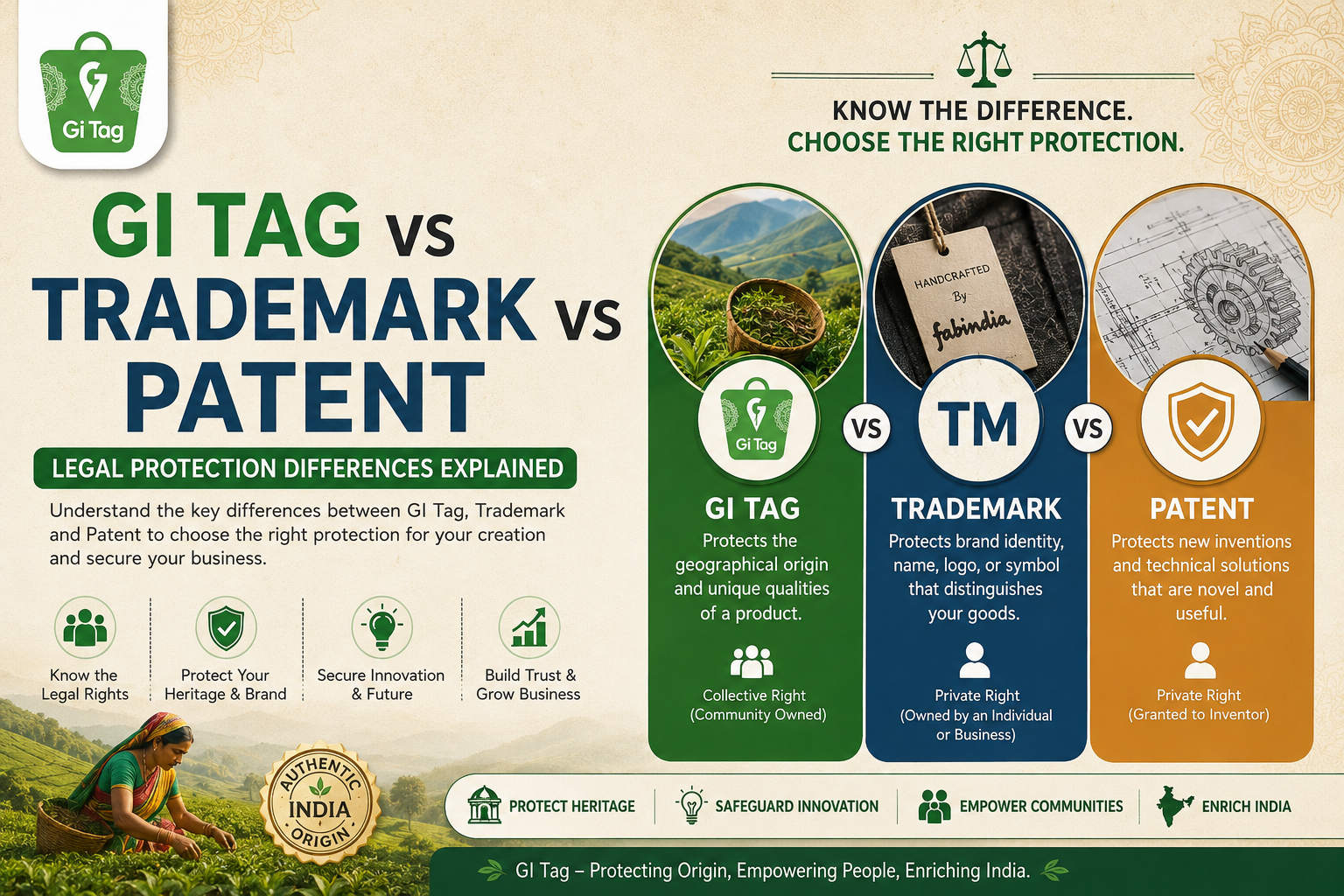
GI Tag vs Trademark vs Patent – Legal Protection Differences
Producers in India need to protect their creations. They must understand the different forms of intellectual property (IP) in the country. Intellectual property (IP), a legal framework that protects creations of the human mind like inventions and brands, provides exclusive commercial rights.
A Geographical Indication (GI) tag, a formal registration that certifies a product possesses unique qualities because of its specific geographic origin, protects regional goods. A trademark, a distinctive legal mark or logo registered to distinguish the products of one company from another, establishes private brand identity.
A patent, a statutory government grant that gives an inventor the exclusive right to make, use, or sell an invention, protects novel technological processes. Selecting the correct registration saves time and secures your business profits.
What is the Main Difference Between GI Tag, Trademark and Patent?
A Geographical Indication protects the collective origin of regional goods, while a trademark secures an individual brand identity and a patent shields a novel invention. These three distinct legal rights protect different forms of intellectual property in India.
Every business needs to evaluate these legal tools to build a strong market presence. The main difference lies in what each tool protects and who owns the right. A patent protects technical innovations that make a product work better. A trademark protects the commercial symbols that identify a specific company. A GI tag protects traditional regional products that belong to an entire community.
Selecting the correct protection prevents competitors from stealing your business ideas. A manufacturer who designs a new type of grinding machine needs a patent. A cooperative of artisans that produces traditional fabrics in a specific village needs a GI tag. A business that sells packaged snacks under a unique name needs a trademark. The government administers these three registration systems through different offices to maintain order in the Indian market.
Producers face intense competition in modern retail spaces. Copycats frequently copy successful brands and traditional crafts to deceive buyers. Registering your assets under the correct legal category prevents this commercial exploitation. This guide examines each of these protections in detail to help you secure your business assets.
What is a GI Tag and What Type of IP Protection Does it Provide?
A Geographical Indication tag protects products possessing a specific regional origin and qualities that exist due to that location. This legal mechanism grants a collective right to registered local producers under the Geographical Indications of Goods Act 1999.
The Geographical Indications of Goods (Registration and Protection) Act 1999, the Indian law that provides registration and protection for regional goods, governs GI tags. A GI tag represents a collective right. This right belongs to the entire community of registered producers in a defined region. No single company or individual can claim exclusive private ownership over a GI name. The legal framework keeps the ownership in the hands of the local community.
Producers must establish a clear link between the quality of the product and its geographical origin. The unique characteristics of the product must arise from local environmental factors. These factors include specific soil conditions, regional climate, and traditional human skills. For example, Darjeeling Tea derives its unique flavor from the climate of the Darjeeling hills. The legal protection ensures that only tea grown in this specific region can use the name Darjeeling. You can read our detailed guide on what is a GI tag and its legal protection to understand this connection.
A GI registration remains valid for ten years. The community can renew the registration indefinitely every ten years. This renewal process ensures permanent protection for traditional knowledge. The Geographical Indications Registry in Chennai, the national government office that processes and maintains all GI registrations in India, handles these applications. You can learn more about the GI tag registration process in India to see how communities apply. Producers and consumers can search the IP India portal, the official government website that manages intellectual property registrations in India, to verify these registrations.
The non-transferable nature of a GI tag is a critical feature. The community cannot sell, license, or transfer the registration to any outside party. This rule protects the local creators from corporate buyouts. A large corporation cannot purchase the rights to a regional craft and move production to a cheaper location. The protection stays tied to the traditional land and the people who live there.
The Geographical Indication system uses specific criteria to grant protection:
- Collective right ownership
- Regional origin requirement
- Ten-year renewable duration
- Non-transferable legal status
- Traditional production methods
Who can register a GI Tag in India?
An individual producer cannot register a GI tag alone. The application must come from a group representing the interests of the local producers. This group can be a registered cooperative, an association of producers, or a government department. For instance, a state-run handloom corporation can apply to protect a local textile craft. The applicant group acts as the registered proprietor, an association of producers or a state body that owns a Geographical Indication registration. This group manages the collective intellectual property right.
The registered proprietor holds the certificate but does not own the product commercially. They oversee the quality standards of the registered goods. They maintain the registry of authorized producers in the region. Individual producers within the region must separately apply to become an authorized user, a local producer registered individually to legally use a protected regional name. This authorized user registration grants specific commercial rights under the GI registry.
This registration process ensures that only genuine local creators use the protected name. An artisan who moves to another state loses the right to use the GI name. This system keeps the economic benefits within the original geographical boundary. You can refer to the Geographical Indications of Goods Act 1999 to study these statutory requirements.
What is a Trademark and How Does it Differ from a GI Tag?
A trademark is a registered sign that distinguishes the goods of one specific business from those of other commercial competitors. It differs from a Geographical Indication tag by granting an individual private right rather than a shared community right.
The Trade Marks Act 1999, the national law that regulates the registration and protection of trademarks in India, governs private brand marks. A trademark is a private right owned by an individual, a partnership firm, or a corporate entity. The registration gives the owner exclusive rights to use the mark in commerce. It prevents other businesses from using a confusingly similar mark for their products. The owner controls the brand and can exclude everyone else from using it.
The primary function of a trademark is brand identification. A trademark consists of a brand name, a logo, a slogan, or a unique color combination. For example, the Amul butter girl logo identifies products from a specific cooperative brand. The trademark protects the commercial reputation of the company.
It does not certify the geographical origin of the ingredients. A company can source ingredients from any region and still use its registered trademark.
A trademark remains valid for ten years from the date of application. The owner can renew the trademark indefinitely every ten years by paying the renewal fee. The Trade Marks Registry, the government office that administers trademark registrations in India, manages these brand filings. You can understand the GI tag full form and meaning to compare this with geographic restrictions.
Unlike a GI tag, a trademark is fully assignable and licensable. The trademark owner can sell the brand rights to another company. They can license the logo to third-party manufacturers. This transferability allows companies to expand their business globally. A company can manufacture trademarked goods anywhere in the world. The legal protection does not depend on a specific geographical boundary.
The trademark system uses specific parameters to grant protection:
- Private ownership model
- Brand identity protection
- Ten-year renewable duration
- Fully assignable status
- Global production flexibility
Can a GI tagged product also have a trademark?
Yes. A GI tagged product can hold a trademark. A producer can use a private trademark alongside a collective GI tag. This combination protects both the regional origin and the individual brand quality.
For example, Darjeeling Tea is a famous registered Geographical Indication. Many private tea companies sell this tea under their own brand names. A company like Tata sells Darjeeling Tea under its private trademark. The GI tag guarantees that the tea comes from the Darjeeling hills. The private trademark guarantees that this specific package of tea meets the quality standards of Tata.
This co-existence provides dual protection. The GI tag prevents outside competitors from using the name Darjeeling. The trademark prevents other tea packers from copying the specific brand packaging and logo. This system benefits both the local farming community and the individual business owner.
The community maintains the reputation of the region. The business builds its unique customer base through its brand name.
What is a Patent and How Does it Differ from GI Tag and Trademark?
A patent is an exclusive legal right that protects a novel, useful, and industrially applicable invention for twenty years. Unlike regional Geographical Indications and commercial trademarks, patents protect new technological processes or products rather than reputations.
The Patents Act 1970, the Indian legislation that establishes the rules for registering and enforcing patents, regulates inventions. A patent is a private right granted to an inventor or an assigned company. The registry grants this protection to encourage research and technical progress. A patent protects how a product works, how it is made, or what it is made of. The owner receives a monopoly to exploit the invention commercially.
An invention must satisfy three key criteria to qualify for a patent. The invention must be completely new. It must involve an inventive step that is not obvious to a skilled person. It must have an industrial application. For example, a new machine that automates the weaving of Kanchipuram silk can receive a patent. The patent protects the technology of the machine. The Kanchipuram silk itself receives protection under a GI tag.
A patent has a fixed protection duration of twenty years from the filing date. Unlike GI tags and trademarks, a patent is not renewable after twenty years. Once the patent expires, the invention enters the public domain. Anyone can then manufacture or sell the invention without paying royalties. The Indian Patent Office, the government department that reviews and grants patent rights in India, handles technical invention applications.
This limited duration balances the interest of the inventor with the progress of society. The inventor enjoys a monopoly for twenty years to recover research costs. Society benefits after twenty years when the technology becomes free for all. This system differs completely from GI tags and trademarks. Geographical Indications and trademarks protect historical reputations and brand identities indefinitely. Patents protect modern technical breakthroughs for a restricted time.
The patent system uses specific requirements to grant protection:
- Novelty requirement
- Twenty-year fixed duration
- Assignable ownership model
- Industrial application utility
- Non-renewable legal status
GI Tag vs Trademark vs Patent – Direct Comparison Table
This section compares the primary intellectual property protections in India across key legal parameters like ownership, duration, transferability, and examples. The detailed comparison table outlines how each legal framework operates under Indian intellectual property statutes.
The comparison table highlights the unique legal status of each protection. Producers must evaluate these parameters before filing an application. A group of regional growers protects their heritage through a GI tag. A business building a proprietary brand chooses a trademark. An inventor launching a new machine secures a patent.
Understanding these differences prevents legal conflicts. Many businesses make the mistake of using the wrong legal category. This error leads to weak protection and possible lawsuit vulnerabilities. We explore the practical choices for producers in the next section.
| Legal Parameter | GI Tag | Trademark | Patent |
|---|---|---|---|
| Governing Act | Geographical Indications of Goods Act 1999 | Trade Marks Act 1999 | Patents Act 1970 |
| Registry | Geographical Indications Registry, Chennai | Trade Marks Registry, India | Indian Patent Office |
| Ownership Type | Collective right | Private right | Private right |
| Protection Duration | Ten years, renewable indefinitely | Ten years, renewable indefinitely | Twenty years, not renewable |
| Transferability | Non-assignable and non-transferable | Fully assignable and licensable | Fully assignable and licensable |
| Basis of Rights | Geographical origin and quality | Brand identity and distinctiveness | Novelty and industrial application |
| Indian Example | Darjeeling Tea or Kanchipuram Silk | Amul logo or Fabindia brand mark | Agricultural tools or drug formulations |
When Should an Indian Artisan or Farmer Choose GI Tag Over Trademark?
An Indian artisan or farmer chooses a Geographical Indication tag to protect a traditional product that derives its unique qualities from a specific region. A trademark serves a producer who wishes to protect a unique private brand identity.
Artisans and farmers must select the correct registration based on their business model. A farmer who grows a unique regional fruit needs a GI tag. This tag certifies that the fruit possesses special qualities due to the local soil. The registration protects the entire farming community in that region from unfair competition.
An artisan group that weaves traditional rugs needs a GI tag. The tag protects the historical reputation of the craft. It prevents mass-produced factory rugs from using the famous regional name. This protection secures the livelihoods of local weavers. You can check our benefits of GI tag for producers and artisans to study the economic impacts.
A producer needs a trademark when building a private business. An artisan who sells handloom shirts under a unique brand name must register a trademark. The trademark protects the specific logo and brand name of the shop. It does not protect the weaving style or the region of origin. It ensures that customers can distinguish this specific shop from other handloom stores.
Sometimes a producer needs both protections. A cooperative of weavers can register a collective GI tag for their regional textile. Individual member weavers can then register their own trademarks. This dual system gives them the best protection. The GI tag stops outside factories from copying their regional style. Their private trademarks help them compete against each other in the market.
How Does GI Tag Enforcement Work When a Company Violates the Registration?
The registered proprietor or authorized user enforces a Geographical Indication tag by filing a civil infringement lawsuit in a district court. The court grants legal remedies including permanent injunctions, damages, and the seizure of counterfeit regional goods.
Enforcement is the most critical step in protecting intellectual property. The Geographical Indications of Goods Act 1999 provides strong civil and criminal remedies against counterfeiters. A company that sells fake goods under a protected GI name violates the law.
The registered proprietor or an authorized user must initiate enforcement. They file a civil infringement lawsuit, a legal action filed in court to stop unauthorized use of a registered intellectual property right. This civil action protects the collective interests of the community. They file this case in a district court, a local state court that hears civil disputes and legal claims within its defined geographic boundary. The court hears these claims to grant immediate legal relief.
The district court has the power to grant several legal remedies. The court can issue a permanent injunction, an official court order that permanently forbids a party from performing a specific unauthorized action. This permanent injunction stops counterfeit sales immediately. The court can award financial damages to the producers. It can order the destruction of all fake products and packaging.
The police have the power to take action. The law allows the police to search and seize counterfeit goods without a warrant. This criminal process provides rapid relief. The police arrest the sellers who distribute fake goods. This active enforcement protects the economic interests of honest producers. It maintains the trust of consumers who buy premium regional products.
Frequently Asked Questions About GI Tag vs Trademark vs Patent
Is a GI tag stronger than a trademark in India?
No. A GI tag is not stronger than a trademark in India because they protect different rights. A Geographical Indication protects a collective regional origin, while a trademark protects a private commercial brand.
These two forms of intellectual property serve different commercial needs. A trademark gives an individual company exclusive rights. The company can stop any competitor from using its brand logo. A GI tag gives a collective right to an entire regional community. The community protects their geographic name but cannot stop members from selling the product. Both legal rights offer strong protection under their respective acts.
Can a trademark become a GI tag?
No. A trademark cannot become a Geographical Indication tag in India. A trademark represents private commercial ownership, whereas a Geographical Indication represents a shared public regional origin.
A private trademark belongs to one specific business. A Geographical Indication belongs to all producers within a defined geographic area. The law does not allow a private brand to convert into a community right. A company cannot claim that its private brand is a public regional product. The two registrations remain separate under Indian law.
Does a GI tag expire in India?
No. A GI tag does not expire in India if the community renews it. The registration remains valid for ten years, and the registered proprietor can renew it indefinitely every ten years.
The renewal process requires paying a standard fee to the Geographical Indications Registry in Chennai. The registry extends the protection for another ten years after each renewal. This system ensures that traditional regional crafts receive permanent protection. In contrast, a patent expires after twenty years and cannot be renewed. The permanent nature of GI protection secures traditional knowledge across generations.
Can an outside company apply for a GI tag?
No. An outside company cannot apply for a Geographical Indication tag. Only an association of producers or a government body operating within the defined geographical boundary can file the application.
The applicant must prove a historical connection to the specific region. An outside company that operates in another state does not satisfy this requirement. The law prevents outside entities from registering local heritage. The Geographical Indications Registry rejects any application that comes from outside the traditional boundary. This rule keeps the legal rights in the hands of the local community.
What happens if someone sells fake GI tagged products?
Sellers of fake Geographical Indication products face severe civil and criminal penalties under Indian law. The court awards damages to the registered producers and orders the police to seize the counterfeit goods.
The Geographical Indications of Goods Act 1999 makes selling counterfeit regional products a punishable offence. The offender faces imprisonment for a term of six months to three years. The court imposes a fine of fifty thousand rupees to two lakh rupees. The registered proprietor can file a civil suit to recover financial losses. These strict penalties deter counterfeiters and protect premium regional brands. You can explore the complete list of GI tagged products in India to identify authentic regional items.