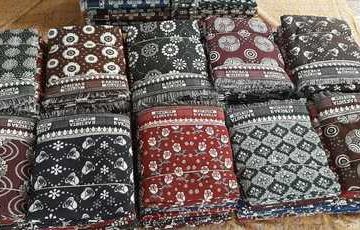
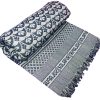
Tawlhlohpuan is not just a textile; it is a pledge woven into thread. Historically, this “puan” (cloth) was reserved exclusively for the most courageous Mizo warriors. To wear it was to declare to the world that you would never retreat in battle. Today, it remains a cornerstone of Mizo identity, celebrated for its heavyweight durability, deep indigo hues, and the legendary “Puanpuizung Thui” stitch that binds its soul together.
SECTION 1: Identity & Legal Status
Feature
Details
GI Product Name
Tawlhlohpuan
GI Certificate No.
351 (Class 24 & 25)
Authorized Region
Mizoram (Mainly Aizawl & Thenzawl)
Status
Registered (Valid until June 19, 2027)
Category
Handicraft (Textile)
SECTION 2: Origin & The Legend of Chivalry
The Hero’s Origin: Emerging roughly 200–300 years ago, this cloth was named after a legendary Mizo soldier.
The “No Retreat” Symbolism: In the Mizo dialect, Tawlhloh means “not to move backward.” In ancient times, it was awarded only to those who displayed extreme chivalry and pledged their life to stand firm.
Evolution of Use: While it began as a warrior’s mark, it has transitioned into a prestigious ceremonial garment worn by both men and women during major festivals like Chapchar Kut.
SECTION 3: The Anatomy of a Masterpiece
What makes Tawlhlohpuan distinct from other Mizo textiles is its specific structural “DNA”:
Two-Piece Construction: Unlike single-sheet fabrics, a genuine Tawlhlohpuan is created by weaving two separate pieces of cloth.
The Signature Stitch: These two pieces are meticulously joined by a hand-stitch called Puanpuizung Thui (using red and white threads).
The Indigo Palette: The weft (horizontal threads) is traditionally made of indigo-dyed black cotton, while the warp (vertical threads) uses undyed white cotton. This creates a deep, rich, midnight-blue base that feels incredibly dense.
Edge Work: Look for the Bahrangulzem stitch on the edges—a hallmark of authentic Mizo craftsmanship.
SECTION 4: Craftsmanship & Process
The creation of a Tawlhlohpuan is a slow-fashion ritual.
Natural Dyeing: Indigo plants are traditionally used to achieve the deep black/blue base colors.
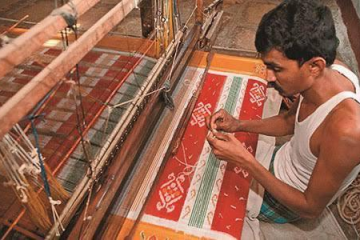
Backstrap Weaving (Puanbu): Most authentic pieces are woven on a loin loom, where the weaver uses their own body weight to maintain tension.
Supplementary Weft: The patterns (bold red, white, and yellow stripes) are manually inserted. This is a “weft-faced” weave, meaning the horizontal threads completely hide the vertical warp, giving the fabric its unique texture.
Time Investment: Because it is a medium-to-heavy fabric with manual pattern insertion, a single unit can take several weeks to months to complete.
SECTION 5: Buyer Safety—Spotting the “Stand Firm” Quality
How to Identify a Genuine Tawlhlohpuan:
The Joinery: Check the center of the fabric. You should see a visible, hand-stitched seam (Puanpuizung Thui) where the two woven halves are joined. Machine-made fakes are usually a single wide sheet.
Tactile Texture: The motifs should feel slightly raised from the base fabric. If the pattern is flat and smooth, it’s likely printed (fake).
The Weight: An authentic Tawlhlohpuan is heavy and compact. If it feels light or “wispy” like common cotton, it isn’t the warrior’s cloth.
The “Stand Firm” Stitch: Look for the specific geometric, cross-like “Puanpuizung” stitch in red and white.
SECTION 6: Market & Economic Impact
Artisanal Reach: This craft is the backbone of Thenzawl and Aizawl, supporting hundreds of specialized female weavers.
Global Footprint: While locally prized, demand has spread to the UK, USA, UAE, and Japan through the Mizo diaspora and luxury textile collectors.
Pricing:
Local/Retail: ₹1,000 – ₹2,500+
Export/E-commerce: ₹2,500 – ₹4,000+ (Reflecting shipping and GI-authentication costs).