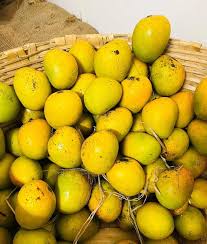
For over 400 years, the Mankurad has been the best-kept secret of the Goan coastline. Known traditionally as Malcorado (Portuguese for “poorly colored”), this mango may not always have the “perfect” uniform look of industrial varieties, but one bite reveals why it is the most expensive and sought-after fruit in the state. With a flavor profile that dances between honey, caramel, and a hint of warm spice, the Mankurad is a fiberless, buttery masterpiece that defines the identity of every Goenkar.
Why this is different
Official GI Tag Authentication: Registered under GI Certificate No. 728, this tag protects the 400-year-old legacy of Goa’s premier indigenous mango.
The “Table Mango” Standard: While other mangoes are often used for pulps or juices, the Mankurad is the ultimate “table fruit”—designed by nature to be sliced and savored fresh.
Buttery & Fiberless: Say goodbye to stringy textures. The Mankurad is famous for its smooth-as-silk pulp and an exceptionally small, flat seed that ensures you get maximum fruit for your money.
Intoxicating Aroma: A single ripe Mankurad is known to fill an entire room with a complex fragrance of honey, floral notes, and a signature “stalk-end perfume.”
Benefits
A Taste of History
The Mankurad isn’t just a fruit; it’s a heritage crop developed by Jesuit priests and local farmers in the 1600s. By choosing the GI-tagged variety, you are:
Supporting 6,000 Goan Farmers: Empowering small-scale orchard owners in clusters like Sattari, Bicholim, and Bardez.
Chemical-Free Ripening: Authentic Mankurads are traditionally ripened in hay (ghaas), ensuring the flavor develops naturally without the use of harmful carbides.
A Natural Superfood: Packed with Vitamin A, C, and essential minerals, grown in the mineral-rich laterite soil that gives Goan produce its distinct “zing.”
Feature Specs: The Connoisseur’s Choice
The Flavor: A rich, complex sweetness with caramel undertones and a delicate, spicy tang (cinnamon and allspice notes).
The Texture: Exceptionally soft, melting pulp with zero fiber.
The Appearance: Medium-sized (200g-350g), vibrant yellow when ripe, often featuring a matte, speckled skin rather than a waxy, artificial shine.
Specifications
Feature
Details
GI Name
Goa Mankurad Mango
GI Certificate No.
728 (Valid until 2030)
Authorized Region
North & South Goa (Primarily Northern belt)
Pulp Quality
High recovery (Small, flat seed)
Harvest Season
April to June (Early season arrival)
Aroma
Intense, honeyed, and floral
Use Cases & Cultural Ritual
The First Harvest Celebration
In Goa, the arrival of the first Mankurad in April is a festive event. It is traditionally eaten fresh as a mid-day treat, sliced vertically to showcase the vibrant saffron flesh.
Luxury Gifting
Due to its premium price (often reaching ₹7,000+ per dozen in early season), the Mankurad is the ultimate luxury gift for weddings, business associates, and family elders.
Traditional Pairings
While best enjoyed alone, a ripe Mankurad pairs exquisitely with a small piece of Goan Bebinca or a scoop of vanilla bean ice cream.
Identifying Real vs. Fake (Buyer Safety)
Don’t pay premium prices for impostors. Here is how to identify the real deal:
The “Sniff” Test: Smell the mango near the stem. A real Mankurad has an overwhelming, sweet, and fruity fragrance. If it smells like nothing or has a chemical/gasoline hint, it is likely a fake.
Skin Over Beauty: Real Mankurads often have a “patchy” yellow-green skin and a matte texture. If the mango looks “too perfect,” shiny, or uniformly orange, it might be a carbide-ripened imitator from another state.
Fiber Check: If you find any stringy fibers while eating, it is not a genuine Mankurad. The pulp must be 100% buttery.
The Seed Factor: Authentic Mankurads have a very thin, flat stone. If the seed is large and round, it is a different variety mislabeled as Mankurad.
[Image showing the small, flat seed of an authentic Mankurad]
FAQ
Why is the Mankurad more expensive than the Alphonso? The Mankurad has a much smaller production area (limited to Goa) and a very short season. Its rarity and superior, fiberless texture make it a high-demand luxury item.
Can I ripen them at home? Yes. If they arrive with a slight green tint, keep them at room temperature in a dark, dry place (preferably in a box with some hay or newspaper).
What does “Malcorado” mean? It’s the original Portuguese name meaning “poorly colored.” It was named this because the skin doesn’t always turn a uniform bright red or orange, even when the inside is perfectly ripe and sweet!
Are these shipped by air? To maintain the delicate, soft texture of the fruit, our Mankurads are handled with extreme care and shipped using expedited logistics to ensure they reach you in peak condition.
Quality Guarantee
Sourced directly from the GI-authorized farming clusters of Sattari and Pernem. Each mango is hand-picked and inspected for the signature “stalk-end perfume” before packing.